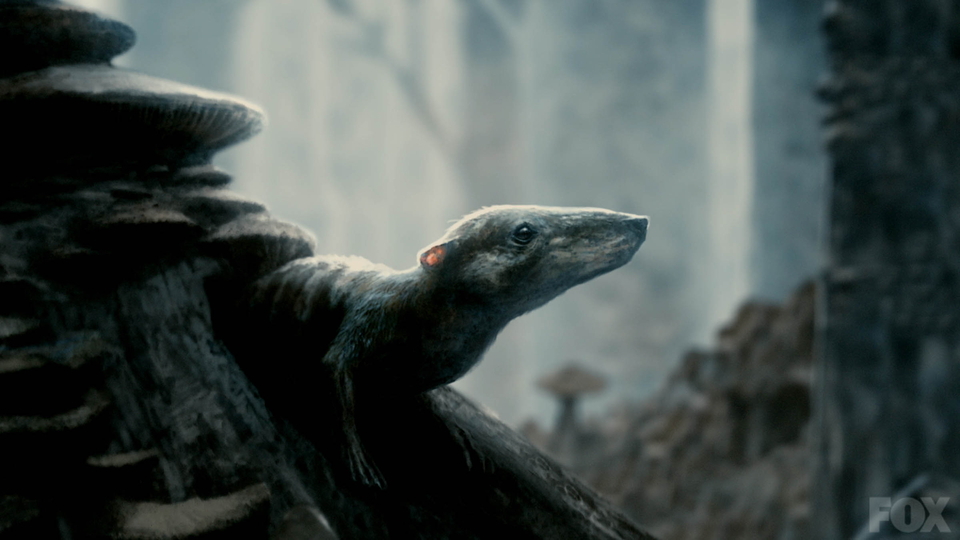
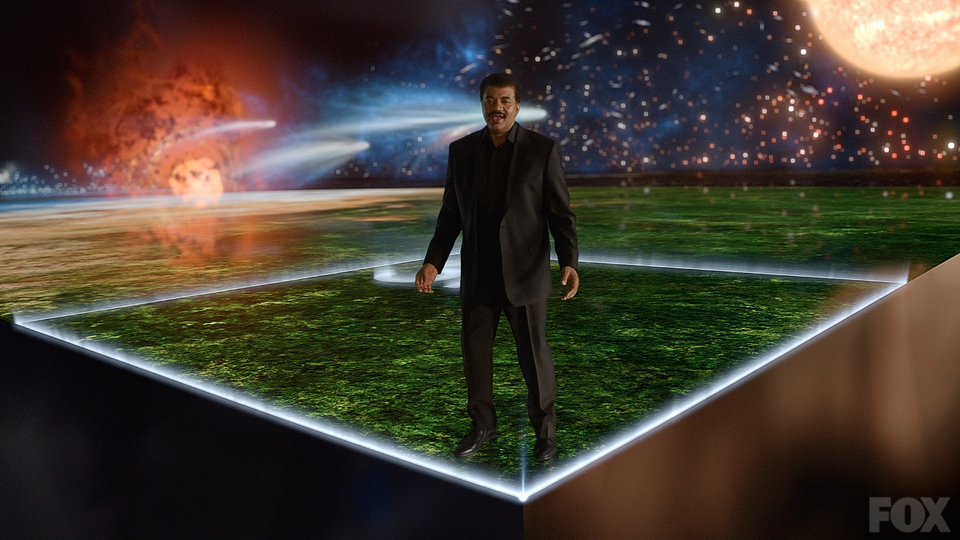
Perhaps all of our great^N-grandmother. (cosmosontv.com)
This episode was a fantastic look at the amazing story of the skin of our home planet, how we came to understand the Earth's history and how it literally set the stage for us all, from the first human to spark a chunk of flint to Shakespeare to you. We learned about mass extinctions and how they gave rise to new eras dominated by different groups of living things, we saw how an overabundance of indigestible plant matter in one epoch became the coal that burned millions of years later to fuel the chain of events that resulted in the Great Dying, and we saw how a tiny isthmus halfway across the globe forced tree-dwelling apes onto the Savannah, eventually forcing them to evolve into you, me, and everybody else.
Unfortunately, the FOX station in New Orleans is apparently run by a producer or two who have yet to make the ape-human transition and didn't want us to hear about it. A friend of mine claims to have seen a similar event to that which made meager headlines in Oklahoma, where the local FOX station cut to a nightly news promo to cover up Neil deGrasse Tyson's mentioning of human descent from the trees. Creationists like this are beyond reproach for their actions, because they obviously haven't even considered the value of viewpoints other than their own, but that doesn't stop me from feeling very, very sorry for them and their myopic little cage in which they lock their intellects.
But that shouldn't stop us from having all the fun they're missing, so let's move on and talk about something interesting!
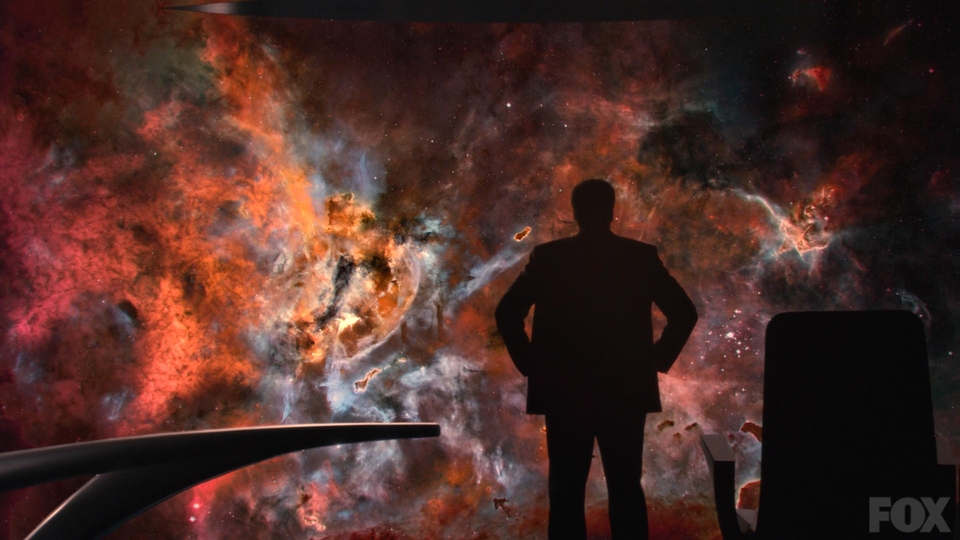
The Carina Nebula is a bustling stellar recycling plant. (cosmosontv.com)
The last two episodes have been wonderful. Both have been able to be much more focused on their respective topics and this episode even delved into a bit more depth than we ever usually see on popular science shows with the short segment on stellar spectral classification. Further, we got to see a second example of scientific growing pains, those first few moments in the life of a profound discovery where it is vulnerable to being quashed and forgotten. Last week's debate over the use of lead in gasoline was due to profit, but this week's rejection of the discovery of the dominance of hydrogen and helium in stellar spectra was due to prestige; scientists can be just as vulnerable to closed-mindedness as the rest of society and must constantly check our biases when examining the data. The importance of keeping an open mind must be constantly balanced against the filtering power of skepticism. Too much of the latter and you'll miss new ideas and discoveries that will advance human knowledge. Too much of the former and you'll... well... do you guys ever watch the History Channel?
But let's move on. There was a lot of mind-blowing science in this episode, so let's get started!
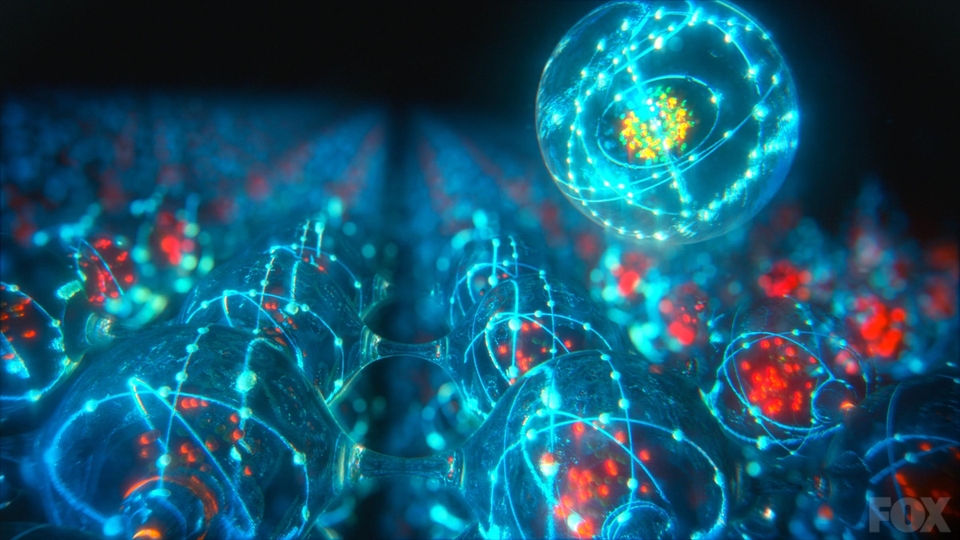
The beauty of crystalline solids on the atomic scale. (cosmosontv.com)
The Bible is hilariously wrong about the age of the Earth, Christmas is just a pagan holiday repurposed by the young Church to attract more converts, and the global warming "debate" is the result of a smokescreen operation on par with those put forward by the lead and tobacco companies to selfishly risk the public health to avoid a hit to their profit margins. For conservatives, truth bombs abound in this episode. Are we still watching FOX? This honest, pull-no-punches approach is all too rare in today's climate of "You believe what you want as long as I don't have to hear about it." Science is founded on questions first and foremost, so it's easy to be laissez-faire with people's deeply-held opinions, but science is also in the business of knowledge and when we work something out to a practical certainty we shouldn't mince words to shelter others from the truth.
So if you're ready to learn more, but especially if you're not, click on through...
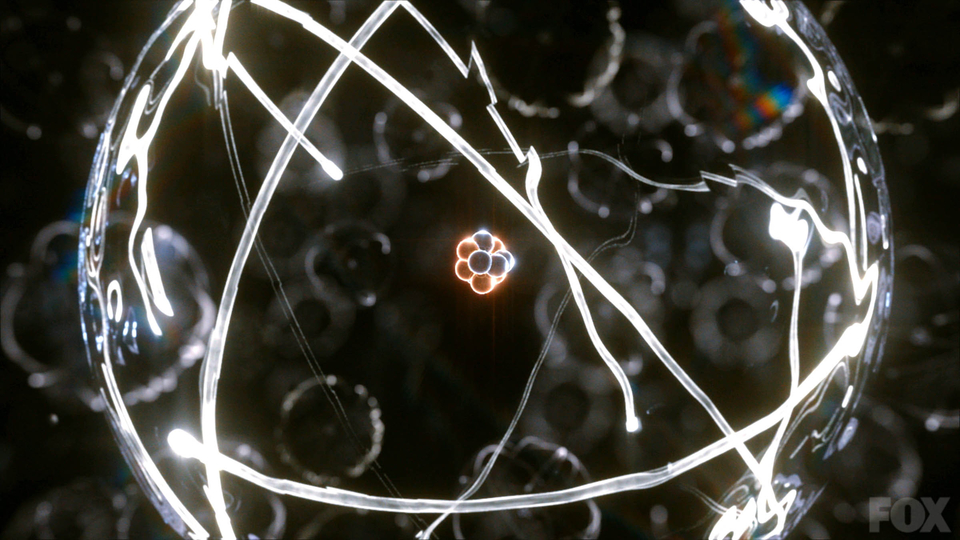
This week takes us from the farthest we can see in the universe to the tiny heart of an atom. (cosmosontv.com)
This week's episode took us from the unfathomably enormous to the unimaginably tiny, with stops along the way at the mind-bendingly complex. We learn immediately that there are more atoms in the tip of your little finger than there are stars in the observable universe, so you know that atoms must be small. Then later in the episode we learn that if an atom were scaled up to the size of a cathedral, the nucleus would be no bigger than a mote of dust. One thing that could have been mentioned here is that the nucleus contains essentially all of the mass of an atom, which makes it incredibly dense. If you could somehow fill a teaspoon with matter as dense as an atomic nucleus, it would weigh 2 billion tons, or about 330 Great Pyramids of Giza. It would be so massive that from about 3.7 meters away (12 feet) it would have the same gravitational pull on you as does the entire Earth. Luckily, these super-dense objects are safely cocooned and separated from one another inside their diffuse electron clouds, which also happen to do all of the chemical bonding work necessary to build complex molecules like DNA and ethanol.
If you thought that was cool, come deeper still and let's get down to nitpicks.
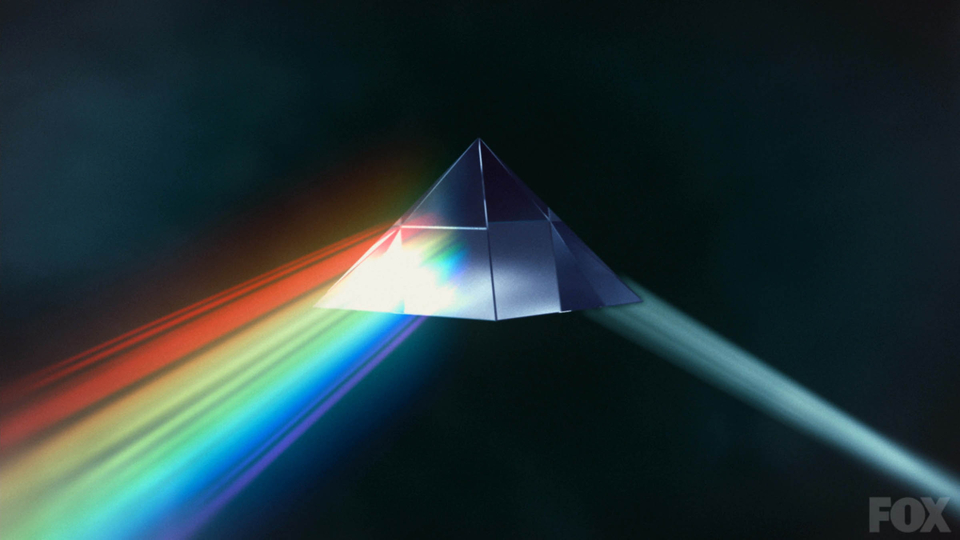
Pink Floyd's major contribution to popular science knowledge. (cosmosontv.com)
It seems that this episode was a bit polarizing. Based on the opinions of those I've spoken with, some people saw one of the more disjointed, rambling, incoherent installments in the series, while I thought it was one of the most engaging and explanatory (Luckily I'm not alone). I really enjoyed the entire story of light, from discovering that it travels in straight lines to finding Fraunhofer's lines in the spectra of distant stars and planets, proving that everything we see in the cosmos is made of the same "human stuff" (chuckles to self).
We'll get to the power of science stuff shortly, but the other thread in this episode was pointing out early steps towards a modern scientific method, the only approach to knowledge that doubts even itself while still leading us to all the mind-warping conclusions that we've been hearing about for the past few weeks. One of the main themes of the show is the fragility of free thought. We've seen fantastic ideas and questions silenced by authorities selfishly preserving their own power from doubt and inquiry, and this week we saw how an act of kindness and the gift of an education lead to huge technological leaps for a different-minded king.
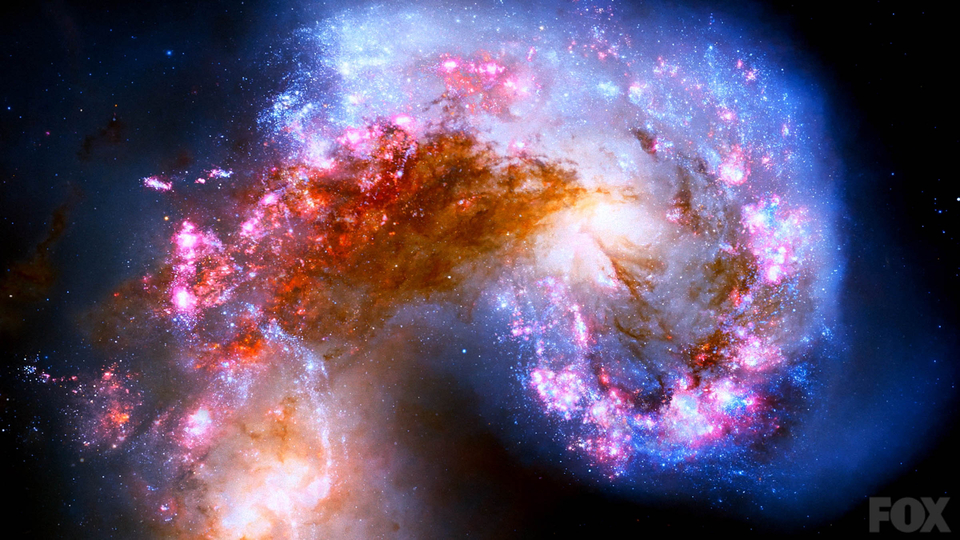
Hubble's view of the Antennae Galaxies made it on TV! (cosmosontv.com)
This week, Neil deGrasse Tyson and Cosmos showed us a little bit of how incredibly strange the Universe can be when you just consider that light travels at a finite speed. The jaw-dropping scene above (discovered by William Herschel!) shows two colliding galaxies as they were 45 million years ago because it has taken the light from this titanic gravitational maelstrom that long to reach us. Given that the lifetimes of the largest and brightest blue stars can be as short as a million years or so, much of the light recorded here comes from long-dead stars—hence the title of this episode.
It's even weirder when you think about travelling at close to the speed of light. Einstein's theory of special relativity basically boils down to "Everyone measures the same speed of light". Then, for emphasis, it adds: "No, I mean it. No matter what absolute nonsense has to be true for that to happen, that's what happens." Note here that "what absolute nonsense has to occur" includes things like time passing more slowly the faster you travel relative to someone else, light shifting wavelengths so that you could see radio waves or gamma rays with your eyes, objects behaving as though they have more mass at high speeds, and on and on. Then, once you add in the principle that gravity is equivalent to acceleration, you get massive objects bending light travelling past them, clocks running slower the closer you are to a massive object, and those ridiculous objects that are so massive not even light can escape their gravity: black holes.
Oh, and maybe there is an infinite hierarchy of other universes in each black hole.
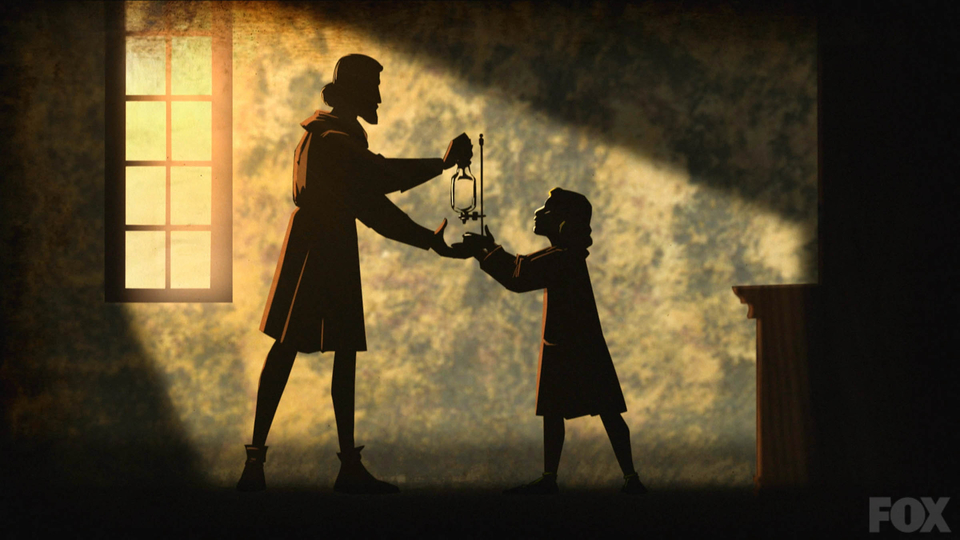
A young Edmond Halley is more curious than frightened. (cosmosontv.com)
Missed this episode? Check it out for free here!
This week, Cosmos took us on a journey from our childlike fear of the unknown to the edge of the Solar System, from astrology to astronomy, and from what we thought was an ad hoc chaos, to the law-abiding cosmos. The story of comets begins with our inchoate understanding of the night sky as a divine gift to aid us in knowing when to sow and when to reap. Any disturbance in such a wondrous and orderly display was certain to foretell some disturbance on Earth, just as the rising of Orion foretells the coming of winter. The Chinese had even worked out a relationship between the kind of disaster and the number of cometary tails!
Kepler's laws of planetary motion implied something simpler was going on, though. The planets didn't move in perfect circles, but rather ellipses with the Sun at one focus. What a peculiar arrangement for God, the ultimate clock-maker, to use—Every good horologist knows that circles are simpler. There had to be a reason, some force that pulls the planets towards the Sun, but no one could think of what it could depend on. After a few interesting speed bumps (like the History of Fish eating up the Royal Society's annual budget), Edmond Halley was able to convince Isaac Newton to publish his Philosophiae Naturalis Principia Mathematica, and are we ever glad he did. Not only did it propose the correct form of the gravitational force (it was considered just a force then, fellow nitpickers), but it detailed the mathematical relationship between the force and the motion of the planets, and introduced us to Newton's Laws of Motion, still the backbone of engineering mechanics over 300 years after their discovery.
The last link in the chain comes with Halley's use of the new gravitational laws to compute the period of the comet which we now call his. He predicted its return 16 years after his death, and when it was confirmed it became the first object known to orbit the Sun apart from the planets. So returning to the original model of comets as harbingers of doom, either God had something nasty in mind every 76 years, or the ancients were a tad oversure of the correlation between disasters and bad stars.
Let's take a look at some of this week's notables:
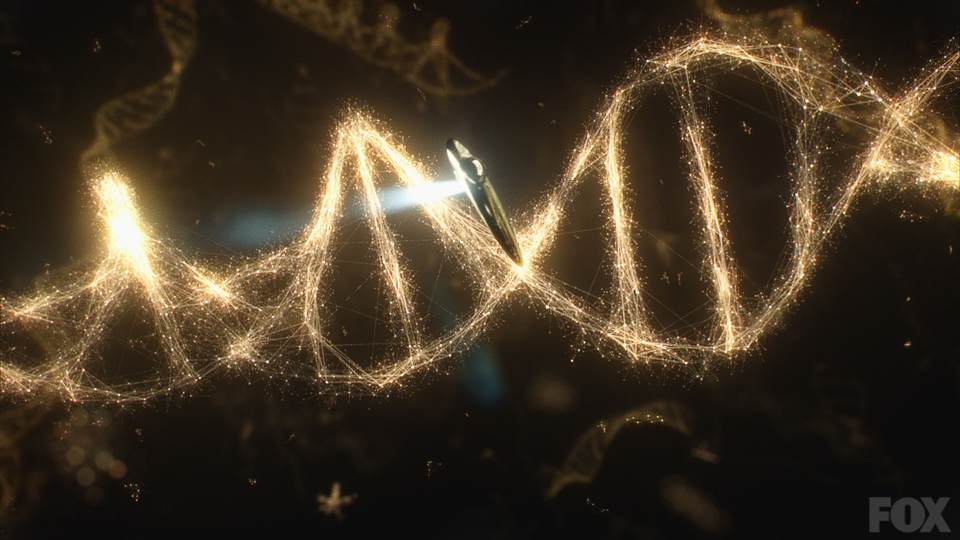
"These are some of the things that molecules do..." (cosmosontv.com)
This week's Cosmos was all about how the "star stuff" from last week managed to stick together into a form that looked up at the stars and discovered where it came from. There are two things that are amazing about the Cosmos, and the first two episodes hit each nail on the head. Last week was about scale: You can't imagine just how big it all is. This is the other half of the cosmic coin: You also can't believe how incredibly complex it is! "There are as many atoms in a strand of your DNA as there are stars in a typical galaxy." Oh, and they didn't mention, but could have, that there are as many galaxies in the observable universe as there are stars in a galaxy too.
The Cosmic Calendar makes its return (cosmosontv.com)
Update: Missed the first episode? No problem, watch it online here!
The premiere of Cosmos was stunningly gorgeous and a great introduction to what I hope is the format for the series: A whirlwind tour of the scientific subject at hand using the Ship of the Imagination and flashy visual effects coupled with an animated story about a weekly "hero" story from the past. Seth MacFarlane and Ann Druyan, the executive producers, have said that the show is aimed at people who never knew they had an interest in science, and the flashy style of the presentation certainly shows that entertainment is a top priority, but even for someone like me (who obviously is already pretty far down the rabbit hole) there was something new, interesting, and provocative on this first episode alone. After a quick look at everything from the scale of the Earth and up, I'm already anxious for the next episode, which looks to be another jaw-dropping romp, this time of the tiny, inner universe between the wisps of our upper atmosphere and the dark bottoms of our oceans.
To bide my time and keep myself from watching all the previews and sneak peeks and spoiling it all, I think I'll publish a quick look each week at the latest episode. I'll try and highlight something I thought was inaccurate (Nitpicks), something I was glad to see in the show (Nods), and something I learned (News). If I can't find something for a category on a given week, then I get to rant a little! Sounds fair? OK, let's get started.
I couldn't be more excited. Finally, after years of teasing and hype, Cosmos, Carl Sagan's mind-expanding love letter to wonder, is returning in a new form, with Neil deGrasse Tyson, the closest thing to a modern Carl, hosting. The show is co-written by Sagan's co-writer, his widow Ann Druyan, and will have animated sequences directed by Seth MacFarlane, the creator of Family Guy. Along with Tyson, these two will give it a connection to the honest and childlike style of the previous incarnation of the series, as well as a fresh look and a new voice. Oh, and I should mention: We've learned a hell of a lot about the cosmos in the last 34 years.
I've seen the whole series (thank you, Netflix), but when I undertook to watch it all together, I realized I already had heard and seen so much of it from other sources. I had heard voice clips of Sagan's poetic narration over video images of terrific beauty, pleading for me, the viewer, to simply look about at the magnificence of all that there is, or ever was, or will ever be; I'd seen video clips from the series with the great demonstrations of the experiments that taught us about who and what we all are; I'd heard phrases and ideas that originated on Cosmos from other scientists, who would often credit Carl as an inspiration to them, as they described the wonder and beauty in scientific investigation. Cosmos truly made an impact.
Sagan and others that have taken his message and carried it like a nobler Olympic flame through the decades have found something amazing and they'd love nothing more than to share it with the whole world. The poetry and the honesty of the original Cosmos has surely touched every person with a love of discovery; anyone who has ever been awed at the immensity of the Universe and then, holding that in mind, tried to comprehend the complexity of a single cell in a drop of water, collected from a puddle of rainwater that at any other moment could be passed by unthinkingly. Carl felt the way we all do when we really ponder these things, he just put it into words for us.
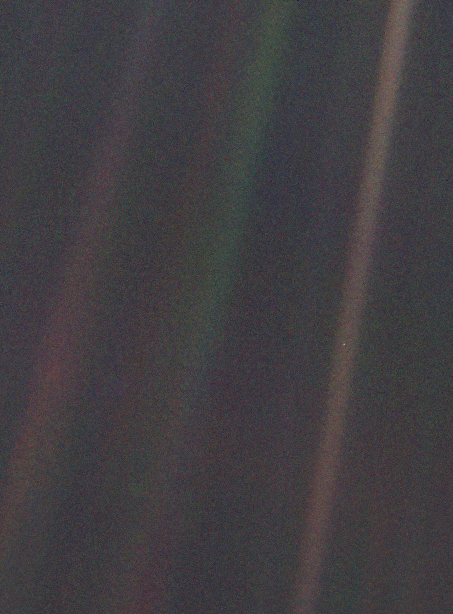
There is beauty and music, in our understanding of the natural world. To give you an idea of what to expect-- What makes me what I am and fills me with excitement, joy, and the drive to go further, learn more, and wonder more deeply-- consider this image of Earth, taken by Voyager 1 as it began to leave our solar system:
Yes, that's us in the center-right. The tiny speck with a blush of blue. Now watch this short video, with audio from the original Cosmos, as Carl tells us what we can all see in this Pale Blue Dot:
This series will impress you with its visual magic, but I hope that some of you can also be amazed and enriched, that you may feel something like the knot that tightens in my chest when I look at this picture with the knowledge of what it is and what it means.
Cosmos: A Spacetime Odyssey premiers the evening of March 9th on your local Fox network.