Showing posts with label Outreach. Show all posts

Monday, January 5, 2015

Cambrian trilobites (Part 1: Where they lived)

This post will come in three parts. First I'll try to give an idea of what the environment was like when trilobites were around, then I'll explain what exactly these things were, and finally I'll tell you how you can go find one for yourself (and how to do so responsibly)!
The head of a trilobite, covered in mud 515 million years ago and hidden until it was pulled out of the rock this fall. What was the world like when these things dominated the waters?

Deep Time

The earth is a dynamic place. From the buzz of an insect's wings to the growth of an acorn into an oak, it seems that there is something interesting happening at every timescale humans are capable of monitoring, yet we know we're missing out on much more when we visit a museum and see the tarnish gathering, like age itself, on ancient weapons and jewelry. Things happening on this scale, centuries to millennia, are already beyond our direct observation, but we can still connect them with the chain of recorded history produced by our ancestors—They are not completely alien to us.

Walk into another wing of the museum however, and you're completely out of your depth. The thread of human history unwinds about 6,000 years ago into frayed, wispy fibers and there is no recorded thought that reaches back more than 40,000 years, to be quite generous. Imagine a race of human-like beings that experienced those 40 millennia as a single year of their impossibly long lives; only then can we even begin to see the real fluidity of our planet. At this scale, the equivalent of a century-old being could witness our full evolution from furry, arboreal apes to thinking, upright humans, while a few generations would be able to notice the motion of the continents. If these long-lived versions of ourselves followed a similar historical arc to scale with ours, the extinction of the dinosaurs would coincide roughly with the founding of their Catholic Church (Which would immediately split into warring factions over the issue of whether the dinosaurs went to Heaven). Within the realm of record, but clouded by age, even to these creatures the dinosaurs would be ancient history!

The oldest scrolls and tablets of their history would record the first mammal-like reptiles' appearance at the dawn of the Triassic period. Their development of agriculture would coincide with the appearance of the first tetrapods, 400 million year-old, newly-legged, near-fishes that would give rise to amphibians and, through them, all reptiles, mammals, and dinosaurs (including birds). Beyond that, this ancient culture would be essentially as devoid of historical reference as we are of life during the last Ice Age, so that even they would have to extract clues to the dawn of multi-cellular life from their equivalent of cave paintings and pottery fragments. The fossil record serves us nearly as well, and so at this point we are finally on near equal-footing. It is this period of time to which the trilobites belong: The ancient history of the ancients.

Sunday, April 27, 2014

We can afford a fully-funded NASA

The group Space Advocates, which I support with a few dollars monthly, has produced this cute video highlighting the broad talking points of how sad the state of funding for NASA is, and how little it would cost us to fix it. Check it out!


Here are a few ways to bring this conversation into the spotlight:
  1. Share this video!
  2. When space comes up in conversation, mention how pathetic it is that we spend many times more money subsidizing the already-booming oil industry than we do maintaining our slipping hold on leadership in space exploration.
  3. Point out that NASA's budget is 40 times smaller than the military's budget. Build rockets, not bombs!
  4. Mention that we will very soon (after 2017) have ZERO functioning spacecraft exploring the outer planets, some of which have moons that could potentially harbor life. The reason? These planets are far away and more costly to reach. That's like hearing there might be treasure buried in your backyard and complaining about how far it is from the couch.
  5. "We should solve our problems here on Earth before we go mucking around in space." Sigh... You are bound to hear this. It's pretty easy to just point out that we already spend 100 times more on social programs to solve problems down here, and that we spend about as much per year on the military (which the kind of person using this excuse might say is spending money on making problems) as we have on all NASA programs in history combined.
There are a lot of other things you can do, but the best thing is to just take a moment to think about how big of an impact we can make if we just turn this into an issue that people care about. Once you've thought about how this matters for a few minutes, then it's a good idea to check out the Space Advocates "Get Involved" page. They'll give you an easy way to write to Congress.

Don't stop there, though! Ask about candidates' positions on the state of funding for space exploration when they're on the campaign trail. If you can get someone to comment on it publicly, their opponents may be forced to join in. Don't give up. It's hard to get the Leviathan moving, but once it's gained momentum we can do great things: See Apollo Program, ISS, Hubble, Cassini, Voyager, Curiosity, and on and on.

Thursday, March 13, 2014

Cosmos Premiere: Nitpicks, Nods, and News

The Cosmic Calendar makes its return (cosmosontv.com)
Update: Missed the first episode? No problem, watch it online here!

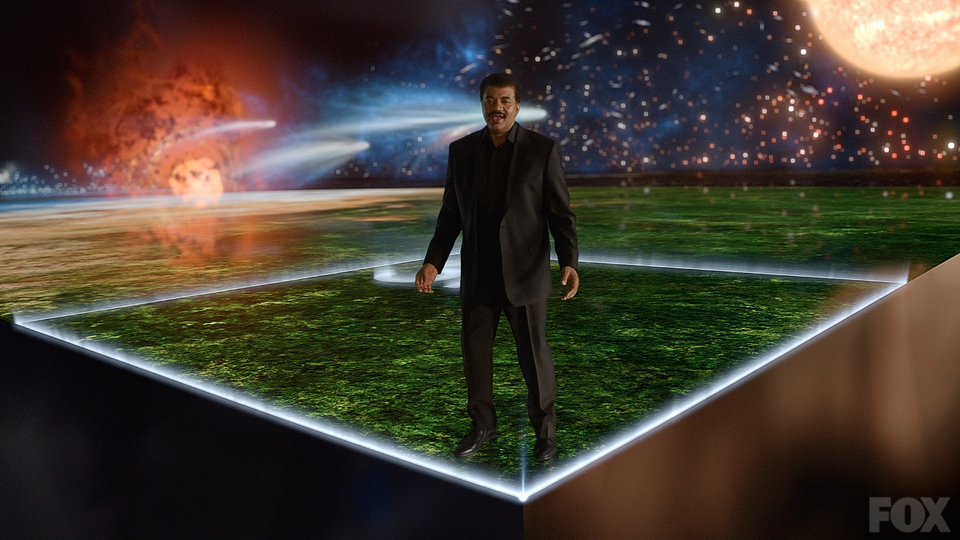
The premiere of Cosmos was stunningly gorgeous and a great introduction to what I hope is the format for the series: A whirlwind tour of the scientific subject at hand using the Ship of the Imagination and flashy visual effects coupled with an animated story about a weekly "hero" story from the past. Seth MacFarlane and Ann Druyan, the executive producers, have said that the show is aimed at people who never knew they had an interest in science, and the flashy style of the presentation certainly shows that entertainment is a top priority, but even for someone like me (who obviously is already pretty far down the rabbit hole) there was something new, interesting, and provocative on this first episode alone. After a quick look at everything from the scale of the Earth and up, I'm already anxious for the next episode, which looks to be another jaw-dropping romp, this time of the tiny, inner universe between the wisps of our upper atmosphere and the dark bottoms of our oceans.

To bide my time and keep myself from watching all the previews and sneak peeks and spoiling it all, I think I'll publish a quick look each week at the latest episode.  I'll try and highlight something I thought was inaccurate (Nitpicks), something I was glad to see in the show (Nods), and something I learned (News). If I can't find something for a category on a given week, then I get to rant a little! Sounds fair? OK, let's get started.

Saturday, March 8, 2014

The return of Cosmos


I couldn't be more excited. Finally, after years of teasing and hype, Cosmos, Carl Sagan's mind-expanding love letter to wonder, is returning in a new form, with Neil deGrasse Tyson, the closest thing to a modern Carl, hosting. The show is co-written by Sagan's co-writer, his widow Ann Druyan, and will have animated sequences directed by Seth MacFarlane, the creator of Family Guy. Along with Tyson, these two will give it a connection to the honest and childlike style of the previous incarnation of the series, as well as a fresh look and a new voice. Oh, and I should mention: We've learned a hell of a lot about the cosmos in the last 34 years.

I've seen the whole series (thank you, Netflix), but when I undertook to watch it all together, I realized I already had heard and seen so much of it from other sources. I had heard voice clips of Sagan's poetic narration over video images of terrific beauty, pleading for me, the viewer, to simply look about at the magnificence of all that there is, or ever was, or will ever be; I'd seen video clips from the series with the great demonstrations of the experiments that taught us about who and what we all are; I'd heard phrases and ideas that originated on Cosmos from other scientists, who would often credit Carl as an inspiration to them, as they described the wonder and beauty in scientific investigation. Cosmos truly made an impact.

Sagan and others that have taken his message and carried it like a nobler Olympic flame through the decades have found something amazing and they'd love nothing more than to share it with the whole world. The poetry and the honesty of the original Cosmos has surely touched every person with a love of discovery; anyone who has ever been awed at the immensity of the Universe and then, holding that in mind, tried to comprehend the complexity of a single cell in a drop of water, collected from a puddle of rainwater that at any other moment could be passed by unthinkingly. Carl felt the way we all do when we really ponder these things, he just put it into words for us.

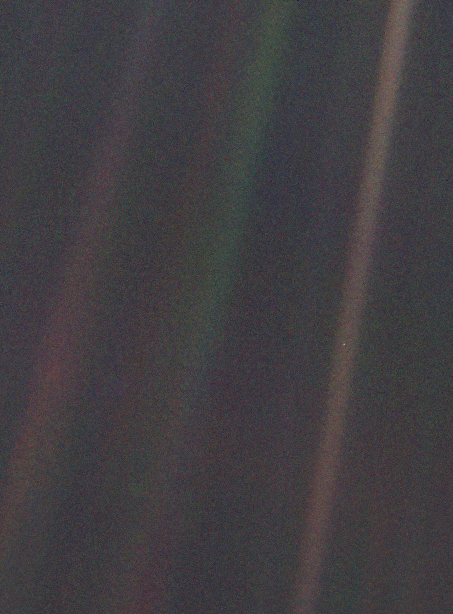
There is beauty and music, in our understanding of the natural world. To give you an idea of what to expect-- What makes me what I am and fills me with excitement, joy, and the drive to go further, learn more, and wonder more deeply-- consider this image of Earth, taken by Voyager 1 as it began to leave our solar system:

Yes, that's us in the center-right. The tiny speck with a blush of blue. Now watch this short video, with audio from the original Cosmos, as Carl tells us what we can all see in this Pale Blue Dot:
This series will impress you with its visual magic, but I hope that some of you can also be amazed and enriched, that you may feel something like the knot that tightens in my chest when I look at this picture with the knowledge of what it is and what it means.

Cosmos: A Spacetime Odyssey premiers the evening of March 9th on your local Fox network.

Wednesday, March 5, 2014

Everybody needs a pet asteroid!

Hello from orbit!

This looks like a good chance to introduce you all to my absolute favorite game of all time, Kerbal Space Program (KSP). It's a fantastically ambitious game that lets you build, fly, and probably crash rockets in a fictional universe where the challenge of space flight is just a little bit simpler than in ours. Play however you want in Sandbox mode, or play a career version of the game where you do science throughout the solar system to earn better parts (engines, fuel tanks, power supplies, etc.) to go further. The game is under development, but the aspects that are included are very polished and you can already play it and receive all future updates for free as the project finalizes.

The reason I bring this up is because the KSP development team has partnered with NASA to develop an in-game version of the Asteroid Redirect Mission (ARM) that will be released very soon. ARM is an incredibly ambitious project in which NASA plans to send a robotic spacecraft to a small asteroid (about 500 tons or so) with an Earth-like orbit, grab on to it, and fly it back to Earth, using some fancy orbital mechanics to swing it into orbit around the Moon. Astronauts would then be sent on the first ever manned flight of the Orion capsule to rendezvous with our moon's new moon (our grandmoon?) and take samples. To me, this is tremendously exciting, as it starts to push us towards the capability to manipulate our environment beyond the Earth. We will become interplanetary engineers! Check out the concept animation below to see how NASA plans to do it.

NASA's concept animation shows their version of how to catch a pet asteroid.

As for the game, players will receive new in-game parts based on real NASA hardware, and the game's solar system will now include asteroids for players to fetch from the depths of space. Since NASA is involved (and it seems that this game is very popular with NASA employees, for obvious reasons), it appears the KSP team is taking this project very seriously, and has included all three major aspects of the ARM mission: Players must Identify a target asteroid of suitable size and favorable orbital alignment, Redirect the object to a suitable location for exploration, and finally Explore their bounty with a manned (or... kerbaled?) mission to investigate it.

The project looks like it could help generate some excitement with the public for the mission which otherwise has received mixed appraisals. One interesting question related to this would be to ask how  this benefits our ability to potentially deflect a dangerous object in the future. As we currently have no plans in place for such an event (not even with the help of a rag-tag bunch of roughneck oilmen and a drunken cosmonaut), this could be the first steps towards developing the relevant technology. What do you think? And (more importantly) what would your ARM mission look like?