Showing posts with label Space Exploration. Show all posts

Sunday, April 27, 2014

We can afford a fully-funded NASA

The group Space Advocates, which I support with a few dollars monthly, has produced this cute video highlighting the broad talking points of how sad the state of funding for NASA is, and how little it would cost us to fix it. Check it out!


Here are a few ways to bring this conversation into the spotlight:
  1. Share this video!
  2. When space comes up in conversation, mention how pathetic it is that we spend many times more money subsidizing the already-booming oil industry than we do maintaining our slipping hold on leadership in space exploration.
  3. Point out that NASA's budget is 40 times smaller than the military's budget. Build rockets, not bombs!
  4. Mention that we will very soon (after 2017) have ZERO functioning spacecraft exploring the outer planets, some of which have moons that could potentially harbor life. The reason? These planets are far away and more costly to reach. That's like hearing there might be treasure buried in your backyard and complaining about how far it is from the couch.
  5. "We should solve our problems here on Earth before we go mucking around in space." Sigh... You are bound to hear this. It's pretty easy to just point out that we already spend 100 times more on social programs to solve problems down here, and that we spend about as much per year on the military (which the kind of person using this excuse might say is spending money on making problems) as we have on all NASA programs in history combined.
There are a lot of other things you can do, but the best thing is to just take a moment to think about how big of an impact we can make if we just turn this into an issue that people care about. Once you've thought about how this matters for a few minutes, then it's a good idea to check out the Space Advocates "Get Involved" page. They'll give you an easy way to write to Congress.

Don't stop there, though! Ask about candidates' positions on the state of funding for space exploration when they're on the campaign trail. If you can get someone to comment on it publicly, their opponents may be forced to join in. Don't give up. It's hard to get the Leviathan moving, but once it's gained momentum we can do great things: See Apollo Program, ISS, Hubble, Cassini, Voyager, Curiosity, and on and on.

Wednesday, March 5, 2014

Everybody needs a pet asteroid!

Hello from orbit!

This looks like a good chance to introduce you all to my absolute favorite game of all time, Kerbal Space Program (KSP). It's a fantastically ambitious game that lets you build, fly, and probably crash rockets in a fictional universe where the challenge of space flight is just a little bit simpler than in ours. Play however you want in Sandbox mode, or play a career version of the game where you do science throughout the solar system to earn better parts (engines, fuel tanks, power supplies, etc.) to go further. The game is under development, but the aspects that are included are very polished and you can already play it and receive all future updates for free as the project finalizes.

The reason I bring this up is because the KSP development team has partnered with NASA to develop an in-game version of the Asteroid Redirect Mission (ARM) that will be released very soon. ARM is an incredibly ambitious project in which NASA plans to send a robotic spacecraft to a small asteroid (about 500 tons or so) with an Earth-like orbit, grab on to it, and fly it back to Earth, using some fancy orbital mechanics to swing it into orbit around the Moon. Astronauts would then be sent on the first ever manned flight of the Orion capsule to rendezvous with our moon's new moon (our grandmoon?) and take samples. To me, this is tremendously exciting, as it starts to push us towards the capability to manipulate our environment beyond the Earth. We will become interplanetary engineers! Check out the concept animation below to see how NASA plans to do it.

NASA's concept animation shows their version of how to catch a pet asteroid.

As for the game, players will receive new in-game parts based on real NASA hardware, and the game's solar system will now include asteroids for players to fetch from the depths of space. Since NASA is involved (and it seems that this game is very popular with NASA employees, for obvious reasons), it appears the KSP team is taking this project very seriously, and has included all three major aspects of the ARM mission: Players must Identify a target asteroid of suitable size and favorable orbital alignment, Redirect the object to a suitable location for exploration, and finally Explore their bounty with a manned (or... kerbaled?) mission to investigate it.

The project looks like it could help generate some excitement with the public for the mission which otherwise has received mixed appraisals. One interesting question related to this would be to ask how  this benefits our ability to potentially deflect a dangerous object in the future. As we currently have no plans in place for such an event (not even with the help of a rag-tag bunch of roughneck oilmen and a drunken cosmonaut), this could be the first steps towards developing the relevant technology. What do you think? And (more importantly) what would your ARM mission look like?

Thursday, January 2, 2014

The clock is ticking on properly funding NASA

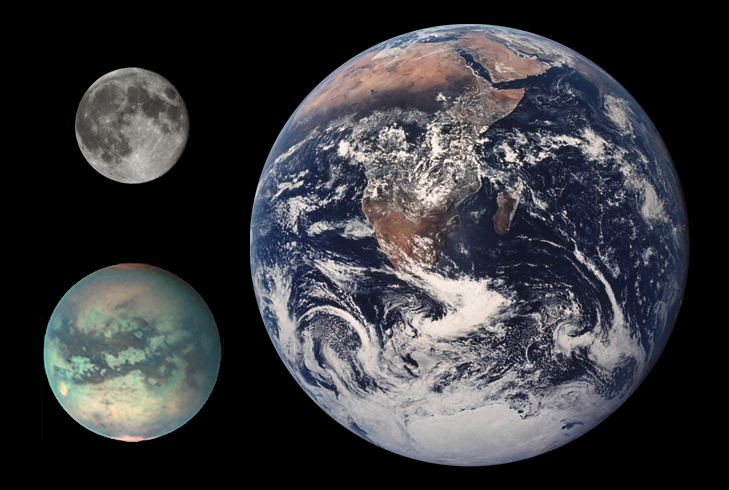
Meet Titan:
Src: Wiki

The above image of Titan (compared with the Earth and Moon) was taken by Cassini, humanity's only ever orbiter around Saturn, which is fighting for its life against budget cuts. The image is not what your eye would see, but rather it is an infrared image which peers through the haze to the surface below. While our eyes would only see a smooth, butterscotch/orange fog, Cassini sees the dark and light areas as different types of terrain. Titan certainly has some interesting features, like boulders of ice, possibly ice volcanoes, and even seas of methane!

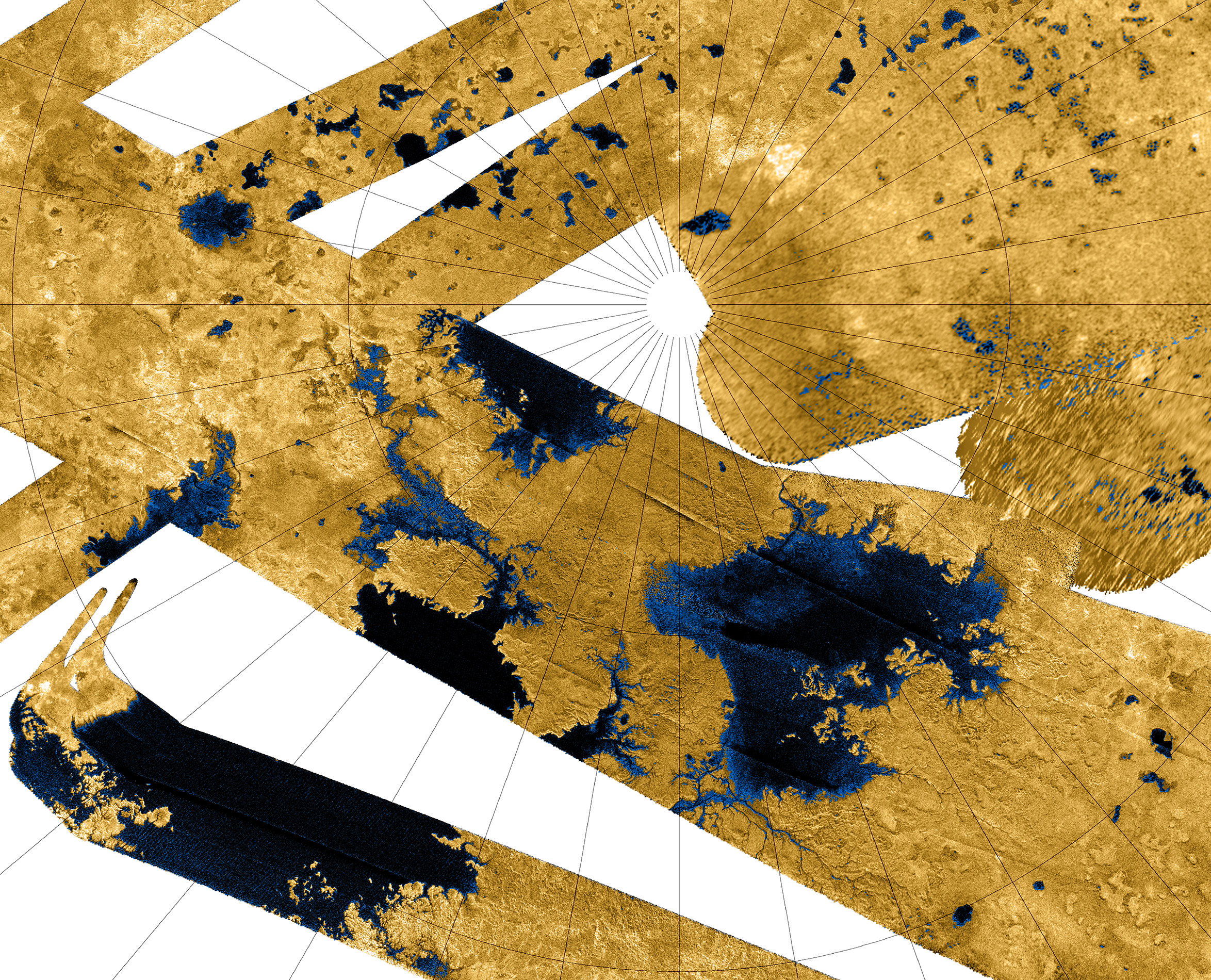
Src: Wiki

This radar image of the north polar region shows seas of methane in dark blue. Titan is so cold that methane, forever a gas on sweltering Earth, actually has a cycle like the water cycle responsible for much of our weather. It exists as a solid, liquid, and gas, and even forms clouds and rain! Titan is one of two known bodies in our solar system with liquid on its surface, and you're sitting on one of them.

This is incredibly exciting, and scientists have been clamoring for a probe to investigate the lakes ever since they were discovered. The problem is that Titan is so incredibly far away, getting a mission out there takes years and sending signals back to Earth takes hours and a lot of power.

Additionally, the lakes are at the north pole which is tilted (like the Earth's pole, which gives us seasons). Since Earth is so close to the Sun (viewed from Saturn), we can basically think of daylight on Titan as a good sign of a line of sight to the Earth. Like our own, Titan's poles experience long periods when the Sun never sets (when the pole is tilted towards the Sun), and long periods where it never rises (when tilted away). Currently, Titan's north pole is tilted toward us, giving us an opportunity to communicate with a probe floating in the lakes directly. In 2025, however, that will change, and the north pole will enter its winter season, never seeing the Sun or Earth for years (until 2040). This gives us a deadline: Get a probe onto the lakes in time to complete its mission before the clock nears 2025, or else we'll have to either wait 15 years, or pay the extra cost of bringing along another Saturn orbiter with our lake probe to relay communications (which may be impractical for other orbital-mechanics-related reasons as well as hugely inflationary for the mission cost).

2025 sounds far away, but when you realize that Cassini took 7 years to reach Saturn, it means that in order to ensure enough time for a successful mission, we'll have to launch our lake probe by 2016 or else there's a good chance we won't see the shorelines of Titan until after 2040. To put it in human terms: If you've got young children now, they'll probably give you grandchildren before we find out what it's like to float on an extraterrestrial sea if we miss this opportunity. The odds are not looking good with the current funding situation though, which highlights again the importance of properly supporting NASA's exploration and science directorates. If you want to find out what's in those seas, then join me in letting Congress know.


Tuesday, December 17, 2013

An open letter to save Planetary Science at NASA

Please feel free to copy+paste this letter and change the names or anything you like to send to your representatives. 

Dear Mr./Ms. President/Senator/Representative,

Due to budget cutbacks, NASA may soon be forced to cut short one of its two most important planetary science missions: The Mars Science Laboratory, Curiosity, and the Cassini Orbiter around Saturn. Despite years of potential life remaining in both vehicles, which have given us wonderful discoveries and images which help captivate and inspire us all --like evidence of fresh, clean water on early Mars and the potential existence of a habitable ocean under the ice of Saturn's moon Enceladus-- one of these missions could soon be cut short in a foolish effort to save an effectively irrelevant sum of money. This is unacceptable, both practically and in principle.

As both of these missions are already active, they require only operational costs to continue providing invaluable data and perspective on our solar system --ending them would mean discarding functioning vehicles already delivered to distant planets at great expense. Further, replacement of these vehicles' capabilities would require an investment of many times the funding required to ensure that both continue operating as planned. If you believe, as I do, that scientific discovery, exploration, technological development, and the marshalling of our best efforts and ingenuity to solve the challenges of space flight have value, then this waste of potential discoveries already within our grasp is not worth the fraction of a fraction of a percent that could be saved from the federal budget by dismantling our crowning achievements. I believe that there are far better, more effective, and less destructive ways of lowering expenses, if that is a goal we wish to achieve.

I also find the very idea of cutting back on our most bold and exciting areas of scientific exploration foolish at a time when people need more than ever to see that the future is bright and that the greatest and most challenging problems can be solved by our best and brightest minds. When pondering the greatest challenges that lay ahead of our civilization, the ingenious systems devised by our engineers and the incredible discoveries made by our scientists are proof that, given the chance, this nation can overcome even the most daunting obstacles. These bold steps taken into the unknown are sure to inspire and energize the minds of millions of young people to dream of better futures for themselves and for all of us. If we long for improvement in our worldly station, then there is no more powerful force that can be marshalled to achieve it than to instill in this generation a dream and the belief that to see the future they have only to dare to build it.

Planetary science at NASA is about more than distant machines exploring the cold, dusty reaches of space; it is about the people who build them, those who use them to discover, and those whose lives are enriched and inspired by the knowledge of our origins. It is about all of us, who live in a world understood and improved every day by those lives. NASA needs $1.5 billion, less than one twentieth of one percent of the 2013 federal budget, for its entire planetary science program to remain funded at levels that will save these missions, most of which is already granted. I support granting them the rest, and I hope you will too.

Thank you,
Dustin Summy

Saturday, November 23, 2013

Don't forget Kennedy's most enduring legacy.

A lot of people are still wrapped up in JFK's presidency, especially the end. Regardless of our obsession with conspiracy (and honestly, how hard is it to believe that a nut took an opportunity and shot the president as he rode by in an uncovered limousine?), let's remember something that Kennedy started that has not stopped affecting the way the entire world works: The Apollo Program.

This is a spectacular video starring a bit of JFK's speech at Rice University. You've all heard the clip "We choose to go to the moon!", but how much of the rest have you heard? It's as relevant today as it was then, and I hope you get that tingling feeling I get every time I watch it.

Enjoy:

Friday, May 10, 2013

The Earth is a Coop to be Flown

When I was growing up, we were lucky enough to live on ten acres of land in the East Texas Piney Woods. We were doubly lucky enough to have a small creek flowing across our property, dividing the "yard" from the "pasture" (that is to say, the "place we mow every two weeks with a lawnmower" from the "place we mow twice a year with a tractor"). Unless you were born to be a politician and are therefore immune to fun, I'm sure you can immediately see the appeal for a pair of school-aged boys.

This looks fairly familiar. via: KM&G-Morris

Friday, April 26, 2013

My letter to Congress in support of funding space exploration.


Dear Senator or Representative,

I strongly oppose the proposed cuts in NASA's budget. I would ideally like to see NASA's funding stay at or above 1% of the total US budget in order to properly fund the more daring and exciting human exploration missions, but I will not accept any cuts to the already low level of funding for planetary science.

My argument is simple:

Recall the landing of the Curiosity Rover on Mars and the enormous amount of public interest that was generated and is maintained as more discoveries pour in. I can't recall a more exhilarating event than that moment (I'm far too young to have experienced the amazing Apollo program) when the descent program worked flawlessly and deposited a metric ton of nuclear-powered, mobile geology lab on the surface of another planet, and a good deal of that excitement comes from the knowledge that this impressive mission is partially my own. My tax dollars were spent on something bold and adventurous, yet peaceful and innocent, probing a distant world for answers to questions that could not be more important to all of us. There is no more noble endeavor than exploration, no more virtuous characteristic of a society than curiosity, and I am proud to support these ideals with the few dollars I have to spare.

The achievements of the planetary science section of NASA are incredible, but they are merely the first drops of an ocean of discovery that awaits us within our solar system. Did you know that we (the human race, not just NASA) have sent only one mission to Uranus and Neptune? Every picture you've seen of the blue and green ice giants and their moons came from a single spacecraft whizzing by in a matter of days using technology developed in the 1960's. Imagine what we could learn with a mission that stayed for years with modern equipment! As interesting a place to look for signs of long-extinct life Mars is, there are potentially entire oceans of life beneath the crusts of moons like Ganymede, Europa, Enceladus, and perhaps even Triton. To paraphrase Neil deGrasse Tyson: I want to drill down to the oceans beneath Europa's crust, stick a camera in, and see if anything licks the lens.

If this sounds more science fiction than science fact to you, please know that I have met countless exceedingly bright scientists and engineers, and I have heard them speak and read their plans at length for entirely feasible missions to accomplish all of these goals. We don't need any miracles to make these dreams come true, we need only the resources - we'll supply the hard work and the intelligence - and along the way we'll discover new technologies with applications back here on Earth. There are those that say that the government can't do anything right, and there may be some departments where that holds, but NASA is not one of them. Given the freedom to follow where the science and engineering lead, the people at this agency can accomplish anything. They have proven it again and again, and they should be rewarded and trusted for it.

Our nation is hungry for the thrill of an open frontier, and here we have dozens of worlds just waiting to be explored. Please support NASA, specifically the planetary and human exploration sectors, and give this generation a chance to be a part of a path of discovery that will literally lead us to a whole new world.

Sincerely,
Dustin Summy