Showing posts with label Science. Show all posts

Monday, January 5, 2015

Cambrian trilobites (Part 1: Where they lived)

This post will come in three parts. First I'll try to give an idea of what the environment was like when trilobites were around, then I'll explain what exactly these things were, and finally I'll tell you how you can go find one for yourself (and how to do so responsibly)!
The head of a trilobite, covered in mud 515 million years ago and hidden until it was pulled out of the rock this fall. What was the world like when these things dominated the waters?

Deep Time

The earth is a dynamic place. From the buzz of an insect's wings to the growth of an acorn into an oak, it seems that there is something interesting happening at every timescale humans are capable of monitoring, yet we know we're missing out on much more when we visit a museum and see the tarnish gathering, like age itself, on ancient weapons and jewelry. Things happening on this scale, centuries to millennia, are already beyond our direct observation, but we can still connect them with the chain of recorded history produced by our ancestors—They are not completely alien to us.

Walk into another wing of the museum however, and you're completely out of your depth. The thread of human history unwinds about 6,000 years ago into frayed, wispy fibers and there is no recorded thought that reaches back more than 40,000 years, to be quite generous. Imagine a race of human-like beings that experienced those 40 millennia as a single year of their impossibly long lives; only then can we even begin to see the real fluidity of our planet. At this scale, the equivalent of a century-old being could witness our full evolution from furry, arboreal apes to thinking, upright humans, while a few generations would be able to notice the motion of the continents. If these long-lived versions of ourselves followed a similar historical arc to scale with ours, the extinction of the dinosaurs would coincide roughly with the founding of their Catholic Church (Which would immediately split into warring factions over the issue of whether the dinosaurs went to Heaven). Within the realm of record, but clouded by age, even to these creatures the dinosaurs would be ancient history!

The oldest scrolls and tablets of their history would record the first mammal-like reptiles' appearance at the dawn of the Triassic period. Their development of agriculture would coincide with the appearance of the first tetrapods, 400 million year-old, newly-legged, near-fishes that would give rise to amphibians and, through them, all reptiles, mammals, and dinosaurs (including birds). Beyond that, this ancient culture would be essentially as devoid of historical reference as we are of life during the last Ice Age, so that even they would have to extract clues to the dawn of multi-cellular life from their equivalent of cave paintings and pottery fragments. The fossil record serves us nearly as well, and so at this point we are finally on near equal-footing. It is this period of time to which the trilobites belong: The ancient history of the ancients.

Tuesday, September 2, 2014

Organic Panic -OR- How I learned to stop worrying and love the produce section!

This article by Christie Wilcox at Scientific American is a very cool-headed look at the concerns supporting the half of the organic food movement concerned with pesticide toxicity (for a look at the debunking of claims of more nutritious and healthy organic food, head over here). It does a great job of casting a wide net and hits all the points:

  • Organic pesticides are not less harmful (short or long term) than conventional pesticides. They are often much more hazardous and stick around longer than the conventional equivalent.
  • Conventional pesticides are tightly controlled, with acceptable limits set to 100 times less than the smallest amount shown to cause harm in a wide range of animal studies (short and long term). Typically, levels detected in actual produce are 100 times below the limit, or 10,000 times less than levels necessary to cause any noticeable harm.
  • Organic pesticides do not have these same controls and guidelines because the same regulations don't apply. You don't know what or how much you're eating. I'm not saying that this is necessarily dangerous, just that you're being hypocritical if you avoid conventional foods to avoid unknown effects of low exposures to pesticides. The organic pesticides are the (relatively) unknown, unstudied, untested option.
  • Organic and conventional farmers show no difference in their overall health, for those of you worried about their exposure.
  • Most pesticide exposure is environmental, and doesn't even come from food-related use of pesticides!
  • There is even evidence for hormesis (a beneficial effect of exposure levels below that shown to cause harm) for many pesticides and other "chemicals". Weird, but true.

You have to think about the difference between the leafy-green, sunshine and rainbows image that the word "organic" puts in your head and what it actually means. I would also prefer to eat food grown on the farm I imagine when I sing "Old McDonald had a farm", but that's not what's going on. What's going on is the creation of a false perception of danger in order to get you to pay more for less. I'd say that sounds more Animal Farm than Old McDonald.

Thursday, May 1, 2014

Cosmos "Sisters of the Sun": Nitpicks, Nods, and News

The Carina Nebula is a bustling stellar recycling plant. (cosmosontv.com)
The last two episodes have been wonderful. Both have been able to be much more focused on their respective topics and this episode even delved into a bit more depth than we ever usually see on popular science shows with the short segment on stellar spectral classification. Further, we got to see a second example of scientific growing pains, those first few moments in the life of a profound discovery where it is vulnerable to being quashed and forgotten. Last week's debate over the use of lead in gasoline was due to profit, but this week's rejection of the discovery of the dominance of hydrogen and helium in stellar spectra was due to prestige; scientists can be just as vulnerable to closed-mindedness as the rest of society and must constantly check our biases when examining the data. The importance of keeping an open mind must be constantly balanced against the filtering power of skepticism. Too much of the latter and you'll miss new ideas and discoveries that will advance human knowledge. Too much of the former and you'll... well... do you guys ever watch the History Channel?

But let's move on. There was a lot of mind-blowing science in this episode, so let's get started!

Thursday, April 24, 2014

Cosmos "The Clean Room": Nitpicks, Nods, and News

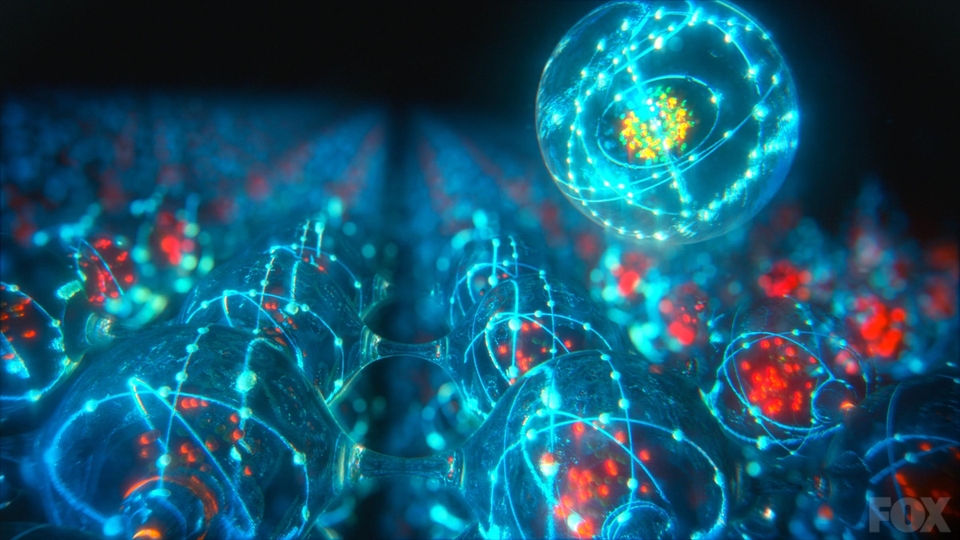
The beauty of crystalline solids on the atomic scale. (cosmosontv.com)
The Bible is hilariously wrong about the age of the Earth, Christmas is just a pagan holiday repurposed by the young Church to attract more converts, and the global warming "debate" is the result of a smokescreen operation on par with those put forward by the lead and tobacco companies to selfishly risk the public health to avoid a hit to their profit margins. For conservatives, truth bombs abound in this episode. Are we still watching FOX? This honest, pull-no-punches approach is all too rare in today's climate of "You believe what you want as long as I don't have to hear about it." Science is founded on questions first and foremost, so it's easy to be laissez-faire with people's deeply-held opinions, but science is also in the business of knowledge and when we work something out to a practical certainty we shouldn't mince words to shelter others from the truth.

So if you're ready to learn more, but especially if you're not, click on through...

Wednesday, April 16, 2014

Cosmos "Deeper, Deeper, and Deeper Still": Nitpicks, Nods, and News

This week takes us from the farthest we can see in the universe to the tiny heart of an atom. (cosmosontv.com)
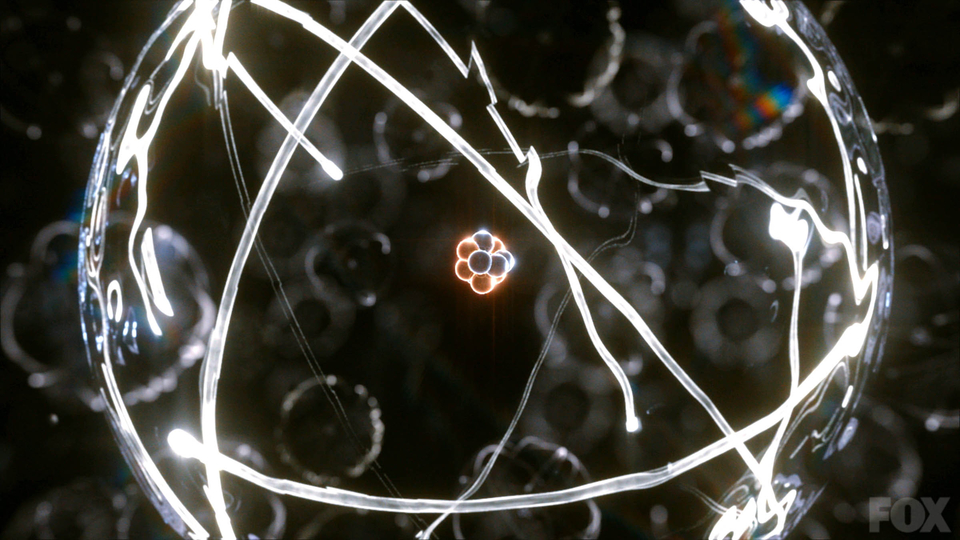
This week's episode took us from the unfathomably enormous to the unimaginably tiny, with stops along the way at the mind-bendingly complex. We learn immediately that there are more atoms in the tip of your little finger than there are stars in the observable universe, so you know that atoms must be small. Then later in the episode we learn that if an atom were scaled up to the size of a cathedral, the nucleus would be no bigger than a mote of dust. One thing that could have been mentioned here is that the nucleus contains essentially all of the mass of an atom, which makes it incredibly dense. If you could somehow fill a teaspoon with matter as dense as an atomic nucleus, it would weigh 2 billion tons, or about 330 Great Pyramids of Giza. It would be so massive that from about 3.7 meters away (12 feet) it would have the same gravitational pull on you as does the entire Earth. Luckily, these super-dense objects are safely cocooned and separated from one another inside their diffuse electron clouds, which also happen to do all of the chemical bonding work necessary to build complex molecules like DNA and ethanol.

If you thought that was cool, come deeper still and let's get down to nitpicks.

Wednesday, April 9, 2014

Cosmos: "Hiding in the Light" Nitpicks, Nods, and News

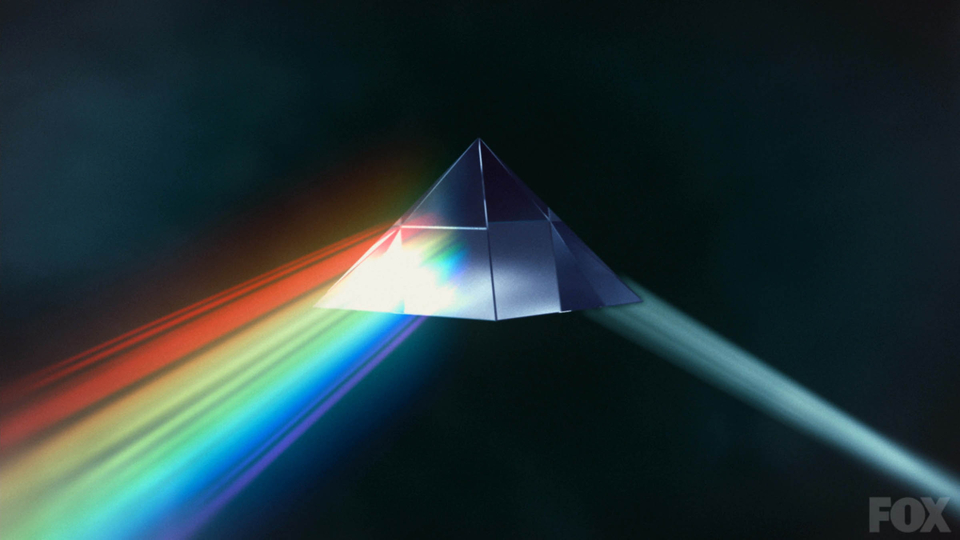
Pink Floyd's major contribution to popular science knowledge. (cosmosontv.com)
It seems that this episode was a bit polarizing. Based on the opinions of those I've spoken with, some people saw one of the more disjointed, rambling, incoherent installments in the series, while I thought it was one of the most engaging and explanatory (Luckily I'm not alone). I really enjoyed the entire story of light, from discovering that it travels in straight lines to finding Fraunhofer's lines in the spectra of distant stars and planets, proving that everything we see in the cosmos is made of the same "human stuff" (chuckles to self).

We'll get to the power of science stuff shortly, but the other thread in this episode was pointing out early steps towards a modern scientific method, the only approach to knowledge that doubts even itself while still leading us to all the mind-warping conclusions that we've been hearing about for the past few weeks. One of the main themes of the show is the fragility of free thought. We've seen fantastic ideas and questions silenced by authorities selfishly preserving their own power from doubt and inquiry, and this week we saw how an act of kindness and the gift of an education lead to huge technological leaps for a different-minded king.

Wednesday, March 26, 2014

Cosmos "When Knowledge Conquered Fear": Nitpicks, Nods, and News

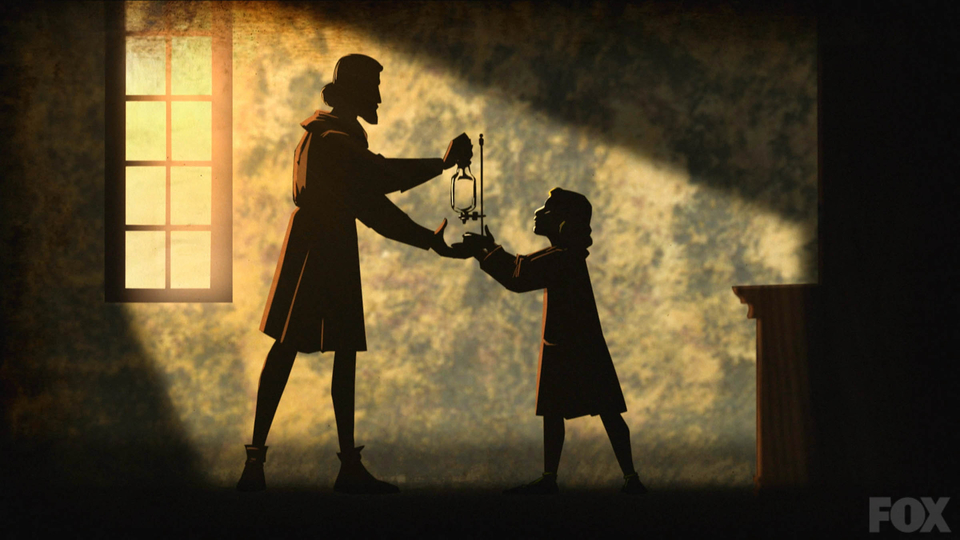
A young Edmond Halley is more curious than frightened. (cosmosontv.com)
Missed this episode? Check it out for free here!
This week, Cosmos took us on a journey from our childlike fear of the unknown to the edge of the Solar System, from astrology to astronomy, and from what we thought was an ad hoc chaos, to the law-abiding cosmos. The story of comets begins with our inchoate understanding of the night sky as a divine gift to aid us in knowing when to sow and when to reap. Any disturbance in such a wondrous and orderly display was certain to foretell some disturbance on Earth, just as the rising of Orion foretells the coming of winter. The Chinese had even worked out a relationship between the kind of disaster and the number of cometary tails!

Kepler's laws of planetary motion implied something simpler was going on, though. The planets didn't move in perfect circles, but rather ellipses with the Sun at one focus. What a peculiar arrangement for God, the ultimate clock-maker, to use—Every good horologist knows that circles are simpler. There had to be a reason, some force that pulls the planets towards the Sun, but no one could think of what it could depend on. After a few interesting speed bumps (like the History of Fish eating up the Royal Society's annual budget), Edmond Halley was able to convince Isaac Newton to publish his Philosophiae Naturalis Principia Mathematica, and are we ever glad he did. Not only did it propose the correct form of the gravitational force (it was considered just a force then, fellow nitpickers), but it detailed the mathematical relationship between the force and the motion of the planets, and introduced us to Newton's Laws of Motion, still the backbone of engineering mechanics over 300 years after their discovery.

The last link in the chain comes with Halley's use of the new gravitational laws to compute the period of the comet which we now call his. He predicted its return 16 years after his death, and when it was confirmed it became the first object known to orbit the Sun apart from the planets. So returning to the original model of comets as harbingers of doom, either God had something nasty in mind every 76 years, or the ancients were a tad oversure of the correlation between disasters and bad stars.

Let's take a look at some of this week's notables:

Thursday, March 13, 2014

Cosmos Premiere: Nitpicks, Nods, and News

The Cosmic Calendar makes its return (cosmosontv.com)
Update: Missed the first episode? No problem, watch it online here!

The premiere of Cosmos was stunningly gorgeous and a great introduction to what I hope is the format for the series: A whirlwind tour of the scientific subject at hand using the Ship of the Imagination and flashy visual effects coupled with an animated story about a weekly "hero" story from the past. Seth MacFarlane and Ann Druyan, the executive producers, have said that the show is aimed at people who never knew they had an interest in science, and the flashy style of the presentation certainly shows that entertainment is a top priority, but even for someone like me (who obviously is already pretty far down the rabbit hole) there was something new, interesting, and provocative on this first episode alone. After a quick look at everything from the scale of the Earth and up, I'm already anxious for the next episode, which looks to be another jaw-dropping romp, this time of the tiny, inner universe between the wisps of our upper atmosphere and the dark bottoms of our oceans.

To bide my time and keep myself from watching all the previews and sneak peeks and spoiling it all, I think I'll publish a quick look each week at the latest episode.  I'll try and highlight something I thought was inaccurate (Nitpicks), something I was glad to see in the show (Nods), and something I learned (News). If I can't find something for a category on a given week, then I get to rant a little! Sounds fair? OK, let's get started.

Saturday, March 8, 2014

The return of Cosmos


I couldn't be more excited. Finally, after years of teasing and hype, Cosmos, Carl Sagan's mind-expanding love letter to wonder, is returning in a new form, with Neil deGrasse Tyson, the closest thing to a modern Carl, hosting. The show is co-written by Sagan's co-writer, his widow Ann Druyan, and will have animated sequences directed by Seth MacFarlane, the creator of Family Guy. Along with Tyson, these two will give it a connection to the honest and childlike style of the previous incarnation of the series, as well as a fresh look and a new voice. Oh, and I should mention: We've learned a hell of a lot about the cosmos in the last 34 years.

I've seen the whole series (thank you, Netflix), but when I undertook to watch it all together, I realized I already had heard and seen so much of it from other sources. I had heard voice clips of Sagan's poetic narration over video images of terrific beauty, pleading for me, the viewer, to simply look about at the magnificence of all that there is, or ever was, or will ever be; I'd seen video clips from the series with the great demonstrations of the experiments that taught us about who and what we all are; I'd heard phrases and ideas that originated on Cosmos from other scientists, who would often credit Carl as an inspiration to them, as they described the wonder and beauty in scientific investigation. Cosmos truly made an impact.

Sagan and others that have taken his message and carried it like a nobler Olympic flame through the decades have found something amazing and they'd love nothing more than to share it with the whole world. The poetry and the honesty of the original Cosmos has surely touched every person with a love of discovery; anyone who has ever been awed at the immensity of the Universe and then, holding that in mind, tried to comprehend the complexity of a single cell in a drop of water, collected from a puddle of rainwater that at any other moment could be passed by unthinkingly. Carl felt the way we all do when we really ponder these things, he just put it into words for us.

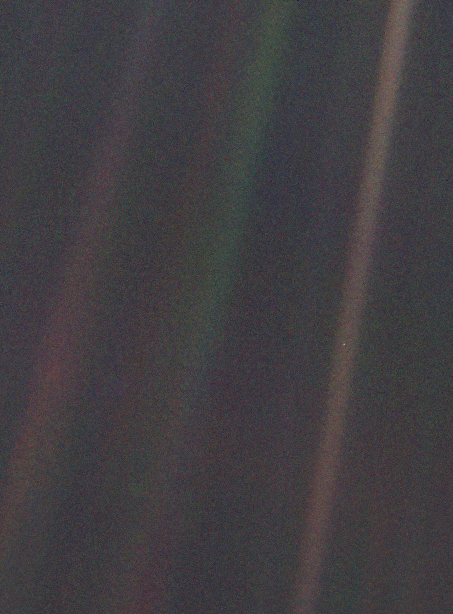
There is beauty and music, in our understanding of the natural world. To give you an idea of what to expect-- What makes me what I am and fills me with excitement, joy, and the drive to go further, learn more, and wonder more deeply-- consider this image of Earth, taken by Voyager 1 as it began to leave our solar system:

Yes, that's us in the center-right. The tiny speck with a blush of blue. Now watch this short video, with audio from the original Cosmos, as Carl tells us what we can all see in this Pale Blue Dot:
This series will impress you with its visual magic, but I hope that some of you can also be amazed and enriched, that you may feel something like the knot that tightens in my chest when I look at this picture with the knowledge of what it is and what it means.

Cosmos: A Spacetime Odyssey premiers the evening of March 9th on your local Fox network.

Wednesday, December 4, 2013

The wonders of evolution - Deep in the heart of Texas

Over the Thanksgiving break, I was fortunate enough to have a chance to visit the Texas Memorial Museum on the University of Texas campus. It's a small building, but each of its four levels is packed with wonderful exhibits. There were some fantastic examples of the weird and wonderful products of evolution on display, not least of which was the 40-foot Quetzalcoatlus northropi fossil soaring over the great hall. I've embedded a slideshow of some photos I took during my visit for you to enjoy. Don't miss the last few photos of comments made by museum patrons about the evolution exhibit. (Album and more after the break)

Sunday, December 1, 2013

Science vs. Wishful Thinking

"Absence of evidence is not evidence of absence." —Traditional
It seems that there is some distance between most people's understanding of this traditional aphorism, often mistakenly attributed in origin to Carl Sagan, and its meaning. The cause in most cases may be found in the nuance of its usage, but I'd like to explain another principle which is likely leaking into its meaning: the impossibility of induction.

Scientific knowledge is based on inductive reasoning; you take a small sample and infer the larger result. This is actually a very bad way of proving things! Imagine being asked to prove that there are infinitely many prime numbers and responding by listing all the prime numbers you can think of, noting that there are more than you can count, and pointing to a bunch of other problems in math that would be solved if there were an infinity of primes. You'd be laughed out of the room if you claimed this was proof of anything in front of a  mathematician! Mathematicians use this kind of reasoning to make conjectures and hypotheses, but since math is based on a set of axioms (facts that are considered true by definition), any claim in mathematics ought to be able to be proven deductively and inarguably (there are some complicated caveats to this, but for the kinds of math useful in practical problems, this is fair to say. Before anyone goes all Gödel on me, consider that you may be being an asshole, you know what I mean.)

Tuesday, July 30, 2013

Memory Engineering

I had no idea when I wrote Death Demystified that there was active research in this field, but it turns out that memory engineering is here (at least in mice, and maybe what's being engineered is more like feelings of unease than real episodic memories... but still!).

The technique is actually very highly advanced: Mice are genetically engineered to produce neurons that are photosensitive. The neuronal patterns associated with one particular habitat are recorded, and later those same neurons are excited by researchers while electric shocks are administered (If mice had a culture, I'm sure they'd all be anti-science hippies) in a second habitat, with the result that (apparently) the mice develop a memory of receiving shocks in the first habitat. The evidence is in their behavior, which includes increased fear-related actions (freezing in place, etc.) in the first habitat, as well as avoiding entering that habitat altogether. All this despite nothing bad ever happening to them in that room. Kind of spooky.

It's still a long way from my little sci-fi tale, but it does seem to make what I thought would be the harder part (implanting the memories and experiences of a simulated brain into a physical one) seem a lot more realistic than I'd imagined. It also should make it more clear that your entire personality and memory are completely encoded in the structure of your brain, not some ethereal super-entity that remains unchanged by petty physical manipulation.

Monday, June 24, 2013

Reason is what is left.

There is a problem with unconstrained human thought that dogmatism is fairly good at correcting over the short run: Sensible, coherent, valid arguments are far more difficult to construct than nonsense, but proper reason is often required in response to bad arguments. The result is that it is easily possible to spend all of one's energy debunking bogus critiques of good works, essentially spinning one's intellectual wheels in an unfathomable quagmire of ignorance or even dishonesty. This is one of the huge benefits of dogmatic thinking- It quashes the spread of heretical ideas and even their formulation in the minds of its subscribers. No lay Catholic need waste time grappling with the intellectual difficulties of salvation and damnation; they already know that the Church is guaranteed to be right.

Those of us who wish to forge ahead into the intellectual frontier are then deprived of the protected status afforded established religions and other doctrines. The result is the production of and response to articles such as "Christopher Hitchens' lies do atheism no favors" by Curtis White. I hesitate to attach adjectives to pieces like this unless they apply to the text as a whole so, while parts may be dishonest or ignorant*, I can't call it anything but depressing. The obviously interested and engaged White is so far off the mark that it enters the realm of things which make the aforementioned unfathomability of the pseudo-intellectual muck readily apparent. From a list of anecdotes as part of his response to Hitchens' so-called anecdotal God Is Not Great, to what seems like an out of hand rejection of the physical manifestation of conscience in the brain**, to a rather obvious straw man argument in which White essentially converts Hitchens' thesis from "religion poisons everything" to "only religion poisons anything".