Showing posts with label Skepticism. Show all posts

Wednesday, April 9, 2014

Cosmos: "Hiding in the Light" Nitpicks, Nods, and News

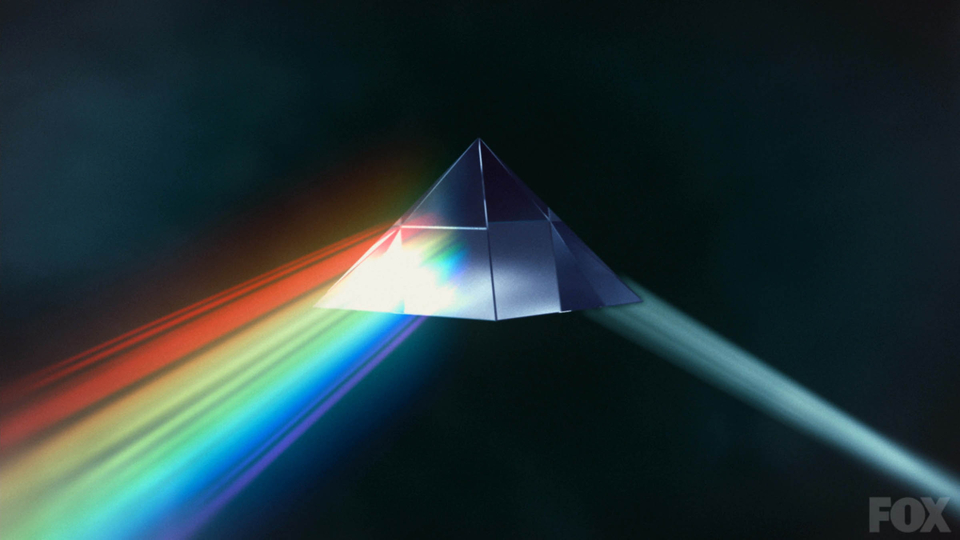
Pink Floyd's major contribution to popular science knowledge. (cosmosontv.com)
It seems that this episode was a bit polarizing. Based on the opinions of those I've spoken with, some people saw one of the more disjointed, rambling, incoherent installments in the series, while I thought it was one of the most engaging and explanatory (Luckily I'm not alone). I really enjoyed the entire story of light, from discovering that it travels in straight lines to finding Fraunhofer's lines in the spectra of distant stars and planets, proving that everything we see in the cosmos is made of the same "human stuff" (chuckles to self).

We'll get to the power of science stuff shortly, but the other thread in this episode was pointing out early steps towards a modern scientific method, the only approach to knowledge that doubts even itself while still leading us to all the mind-warping conclusions that we've been hearing about for the past few weeks. One of the main themes of the show is the fragility of free thought. We've seen fantastic ideas and questions silenced by authorities selfishly preserving their own power from doubt and inquiry, and this week we saw how an act of kindness and the gift of an education lead to huge technological leaps for a different-minded king.

Saturday, March 8, 2014

A bad reason for supporting marriage equality

A group Republicans have filed a legal brief containing their argument for rejecting prohibitions on civil marriage between partners of the same sex. While we agree in the end, I must say some of their reasons are specious. There are tons of reasons to allow everyone to marry the consenting adult of their choice; we don't need the bad ones. Let's start with their quoting of this passage from this report on marriage from the National Marriage Project:

Children who grow up with cohabiting couples tend to have more negative life outcomes compared to those growing up with married couples. Prominent reasons are that cohabiting couples have a much higher breakup rate than do married couples, a lower level of household income, and a higher level of child abuse and domestic violence.

Sounds good, right? I mean, married couples raise children with less negative life outcomes. So more marriage = better families and better lives for kids? Not necessarily. In fact, this is a perfect example of correlation not implying causation. Just because married partners do a better job of raising their kids than unmarried partners doesn't imply that getting married will make two people better parents. In fact, when you say it that way it sounds kind of crazy.

Take Alice and Bob (sorry, I know I shouldn't use these names unless I'm talking about the firewall paradox or encryption protocols), a couple of crack addicts who are madly in love with each other as long as there is enough money to stay high, but whose chemically-enhanced bliss devolves into a melee after a day without a visit from their dealer. Lately they have had to choose between buying condoms and buying more crack, and are soon to discover the consequences of their decision. How good a parenting pair will they be? What if they got married?

Take Carl and Doug (I don't know the standard names past Alice and Bob!), Carl works for a software company and Doug is a moderately successful artist (the kind that wouldn't starve even without Carl, but that isn't famous enough that anyone would recognize the name Doug). They love spending time with their nieces and nephews, whom they babysit regularly. They are thinking of adopting kids and have started combing the parenting section of Amazon books. Would they be better parents if they lived in California (and hence had gotten married) or if they lived in Texas (and hence were "just roommates")? For that matter, what if they lived in California but just didn't believe in marriage? Is that a strike against them?

Maybe the kinds of people who are interested and invested in raising their kids the right way (and would therefore be predisposed to be good parents) are also more likely to be enchanted by the romantic ideal of being married and raising a family a la the Cleavers. Maybe. Maybe not. But I doubt the actual act of getting married has much to do with how well adjusted a couple's children will be, whether it's legal or not in your state.

Think of this the next time you hear a correlation used as evidence of causation in a political debate or column. It'll save you time by letting you wave your hand dismissively at the monitor/TV screen and mutter "Cum hoc ergo propter hoc", because correlation does not imply causation!
Sunday, December 1, 2013

Science vs. Wishful Thinking

"Absence of evidence is not evidence of absence." —Traditional
It seems that there is some distance between most people's understanding of this traditional aphorism, often mistakenly attributed in origin to Carl Sagan, and its meaning. The cause in most cases may be found in the nuance of its usage, but I'd like to explain another principle which is likely leaking into its meaning: the impossibility of induction.

Scientific knowledge is based on inductive reasoning; you take a small sample and infer the larger result. This is actually a very bad way of proving things! Imagine being asked to prove that there are infinitely many prime numbers and responding by listing all the prime numbers you can think of, noting that there are more than you can count, and pointing to a bunch of other problems in math that would be solved if there were an infinity of primes. You'd be laughed out of the room if you claimed this was proof of anything in front of a  mathematician! Mathematicians use this kind of reasoning to make conjectures and hypotheses, but since math is based on a set of axioms (facts that are considered true by definition), any claim in mathematics ought to be able to be proven deductively and inarguably (there are some complicated caveats to this, but for the kinds of math useful in practical problems, this is fair to say. Before anyone goes all Gödel on me, consider that you may be being an asshole, you know what I mean.)

Monday, June 24, 2013

Reason is what is left.

There is a problem with unconstrained human thought that dogmatism is fairly good at correcting over the short run: Sensible, coherent, valid arguments are far more difficult to construct than nonsense, but proper reason is often required in response to bad arguments. The result is that it is easily possible to spend all of one's energy debunking bogus critiques of good works, essentially spinning one's intellectual wheels in an unfathomable quagmire of ignorance or even dishonesty. This is one of the huge benefits of dogmatic thinking- It quashes the spread of heretical ideas and even their formulation in the minds of its subscribers. No lay Catholic need waste time grappling with the intellectual difficulties of salvation and damnation; they already know that the Church is guaranteed to be right.

Those of us who wish to forge ahead into the intellectual frontier are then deprived of the protected status afforded established religions and other doctrines. The result is the production of and response to articles such as "Christopher Hitchens' lies do atheism no favors" by Curtis White. I hesitate to attach adjectives to pieces like this unless they apply to the text as a whole so, while parts may be dishonest or ignorant*, I can't call it anything but depressing. The obviously interested and engaged White is so far off the mark that it enters the realm of things which make the aforementioned unfathomability of the pseudo-intellectual muck readily apparent. From a list of anecdotes as part of his response to Hitchens' so-called anecdotal God Is Not Great, to what seems like an out of hand rejection of the physical manifestation of conscience in the brain**, to a rather obvious straw man argument in which White essentially converts Hitchens' thesis from "religion poisons everything" to "only religion poisons anything".