Tuesday, April 15, 2014
Going Deeper: "Is it wrong to talk people out of their faith?"
Hey everyone. I've noticed a few interesting points in the flood of comments on my article at RDFRS that I'd like to respond to. I'll keep updating this post as I find interesting points to comment on, so keep checking in.

Wednesday, April 9, 2014
Cosmos: "Hiding in the Light" Nitpicks, Nods, and News
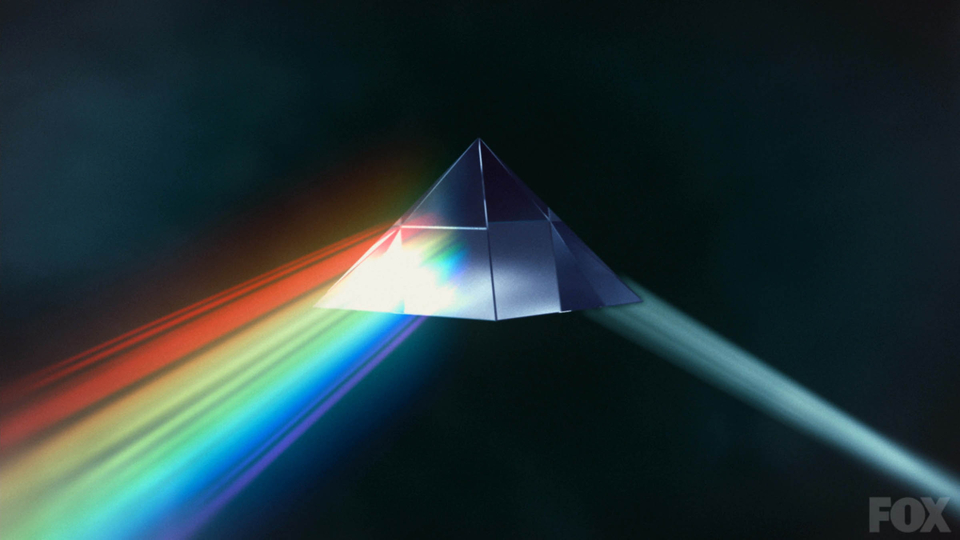 |
| Pink Floyd's major contribution to popular science knowledge. (cosmosontv.com) |
We'll get to the power of science stuff shortly, but the other thread in this episode was pointing out early steps towards a modern scientific method, the only approach to knowledge that doubts even itself while still leading us to all the mind-warping conclusions that we've been hearing about for the past few weeks. One of the main themes of the show is the fragility of free thought. We've seen fantastic ideas and questions silenced by authorities selfishly preserving their own power from doubt and inquiry, and this week we saw how an act of kindness and the gift of an education lead to huge technological leaps for a different-minded king.
Thursday, April 3, 2014
Cosmos "A Sky Full of Ghosts". Nitpicks, Nods, and News.
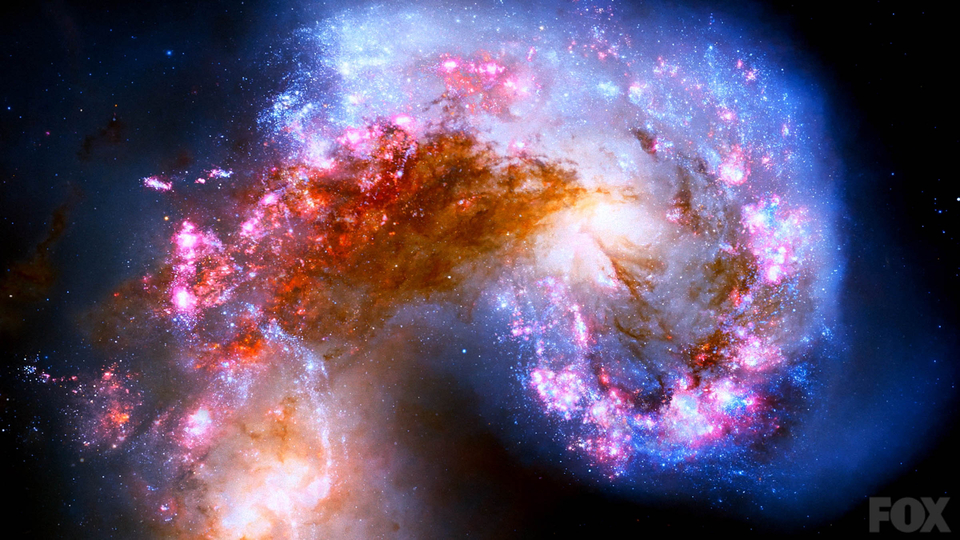 |
| Hubble's view of the Antennae Galaxies made it on TV! (cosmosontv.com) |
It's even weirder when you think about travelling at close to the speed of light. Einstein's theory of special relativity basically boils down to "Everyone measures the same speed of light". Then, for emphasis, it adds: "No, I mean it. No matter what absolute nonsense has to be true for that to happen, that's what happens." Note here that "what absolute nonsense has to occur" includes things like time passing more slowly the faster you travel relative to someone else, light shifting wavelengths so that you could see radio waves or gamma rays with your eyes, objects behaving as though they have more mass at high speeds, and on and on. Then, once you add in the principle that gravity is equivalent to acceleration, you get massive objects bending light travelling past them, clocks running slower the closer you are to a massive object, and those ridiculous objects that are so massive not even light can escape their gravity: black holes.
Oh, and maybe there is an infinite hierarchy of other universes in each black hole.
Let's get started!
Wednesday, March 26, 2014
Cosmos "When Knowledge Conquered Fear": Nitpicks, Nods, and News
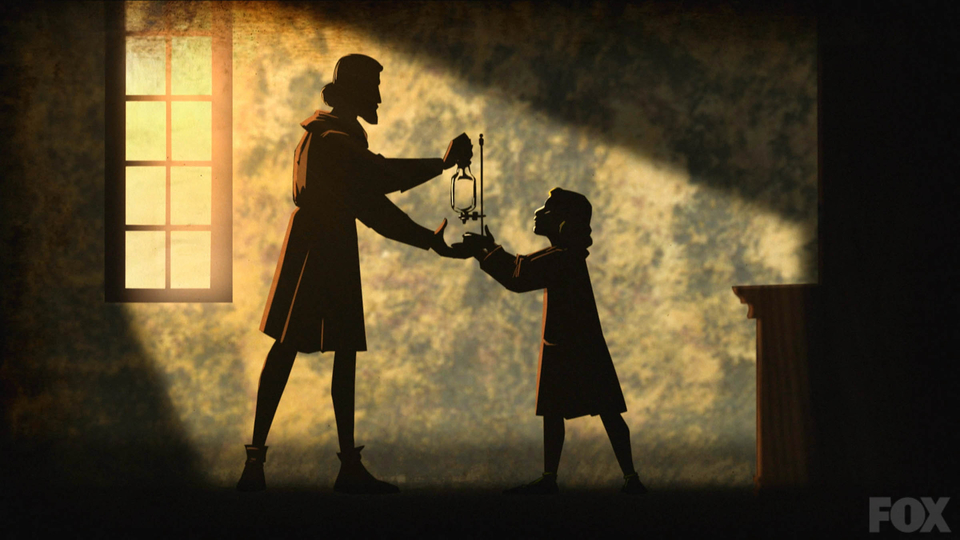 |
| A young Edmond Halley is more curious than frightened. (cosmosontv.com) |
This week, Cosmos took us on a journey from our childlike fear of the unknown to the edge of the Solar System, from astrology to astronomy, and from what we thought was an ad hoc chaos, to the law-abiding cosmos. The story of comets begins with our inchoate understanding of the night sky as a divine gift to aid us in knowing when to sow and when to reap. Any disturbance in such a wondrous and orderly display was certain to foretell some disturbance on Earth, just as the rising of Orion foretells the coming of winter. The Chinese had even worked out a relationship between the kind of disaster and the number of cometary tails!
Kepler's laws of planetary motion implied something simpler was going on, though. The planets didn't move in perfect circles, but rather ellipses with the Sun at one focus. What a peculiar arrangement for God, the ultimate clock-maker, to use—Every good horologist knows that circles are simpler. There had to be a reason, some force that pulls the planets towards the Sun, but no one could think of what it could depend on. After a few interesting speed bumps (like the History of Fish eating up the Royal Society's annual budget), Edmond Halley was able to convince Isaac Newton to publish his Philosophiae Naturalis Principia Mathematica, and are we ever glad he did. Not only did it propose the correct form of the gravitational force (it was considered just a force then, fellow nitpickers), but it detailed the mathematical relationship between the force and the motion of the planets, and introduced us to Newton's Laws of Motion, still the backbone of engineering mechanics over 300 years after their discovery.
The last link in the chain comes with Halley's use of the new gravitational laws to compute the period of the comet which we now call his. He predicted its return 16 years after his death, and when it was confirmed it became the first object known to orbit the Sun apart from the planets. So returning to the original model of comets as harbingers of doom, either God had something nasty in mind every 76 years, or the ancients were a tad oversure of the correlation between disasters and bad stars.
Let's take a look at some of this week's notables:
Wednesday, March 19, 2014
Cosmos: "Some of the Things that Molecules Do" Nitpicks, Nods, and News
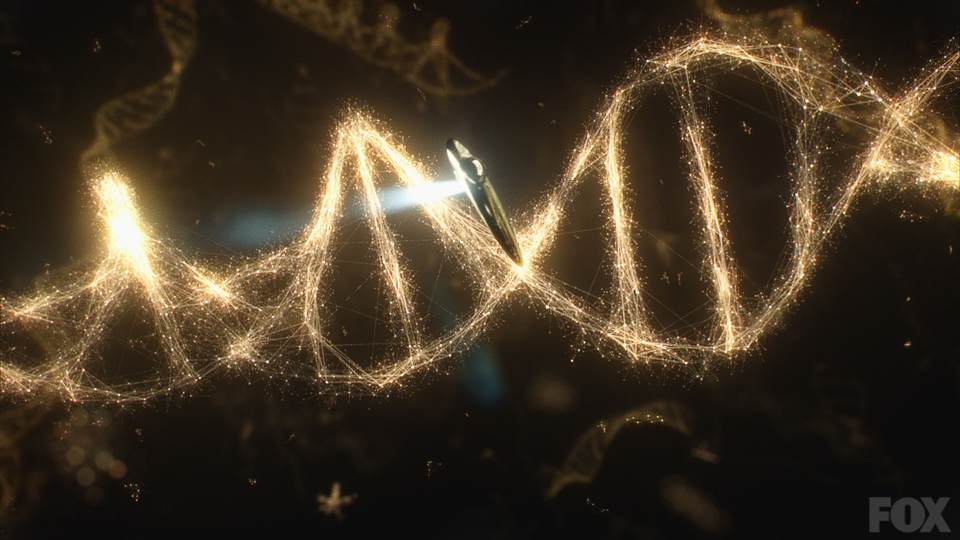 |
| "These are some of the things that molecules do..." (cosmosontv.com) |
It's. So. Big. And. Complex. I. Don't. Even...
Thursday, March 13, 2014
Cosmos Premiere: Nitpicks, Nods, and News
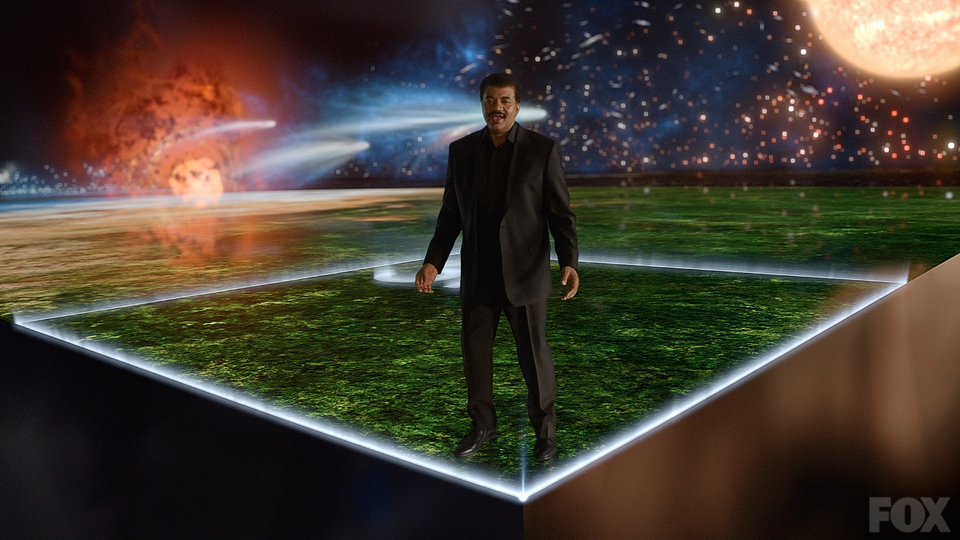 |
| The Cosmic Calendar makes its return (cosmosontv.com) |
The premiere of Cosmos was stunningly gorgeous and a great introduction to what I hope is the format for the series: A whirlwind tour of the scientific subject at hand using the Ship of the Imagination and flashy visual effects coupled with an animated story about a weekly "hero" story from the past. Seth MacFarlane and Ann Druyan, the executive producers, have said that the show is aimed at people who never knew they had an interest in science, and the flashy style of the presentation certainly shows that entertainment is a top priority, but even for someone like me (who obviously is already pretty far down the rabbit hole) there was something new, interesting, and provocative on this first episode alone. After a quick look at everything from the scale of the Earth and up, I'm already anxious for the next episode, which looks to be another jaw-dropping romp, this time of the tiny, inner universe between the wisps of our upper atmosphere and the dark bottoms of our oceans.
To bide my time and keep myself from watching all the previews and sneak peeks and spoiling it all, I think I'll publish a quick look each week at the latest episode. I'll try and highlight something I thought was inaccurate (Nitpicks), something I was glad to see in the show (Nods), and something I learned (News). If I can't find something for a category on a given week, then I get to rant a little! Sounds fair? OK, let's get started.
Saturday, March 8, 2014
The return of Cosmos

I couldn't be more excited. Finally, after years of teasing and hype, Cosmos, Carl Sagan's mind-expanding love letter to wonder, is returning in a new form, with Neil deGrasse Tyson, the closest thing to a modern Carl, hosting. The show is co-written by Sagan's co-writer, his widow Ann Druyan, and will have animated sequences directed by Seth MacFarlane, the creator of Family Guy. Along with Tyson, these two will give it a connection to the honest and childlike style of the previous incarnation of the series, as well as a fresh look and a new voice. Oh, and I should mention: We've learned a hell of a lot about the cosmos in the last 34 years.
I've seen the whole series (thank you, Netflix), but when I undertook to watch it all together, I realized I already had heard and seen so much of it from other sources. I had heard voice clips of Sagan's poetic narration over video images of terrific beauty, pleading for me, the viewer, to simply look about at the magnificence of all that there is, or ever was, or will ever be; I'd seen video clips from the series with the great demonstrations of the experiments that taught us about who and what we all are; I'd heard phrases and ideas that originated on Cosmos from other scientists, who would often credit Carl as an inspiration to them, as they described the wonder and beauty in scientific investigation. Cosmos truly made an impact.
Sagan and others that have taken his message and carried it like a nobler Olympic flame through the decades have found something amazing and they'd love nothing more than to share it with the whole world. The poetry and the honesty of the original Cosmos has surely touched every person with a love of discovery; anyone who has ever been awed at the immensity of the Universe and then, holding that in mind, tried to comprehend the complexity of a single cell in a drop of water, collected from a puddle of rainwater that at any other moment could be passed by unthinkingly. Carl felt the way we all do when we really ponder these things, he just put it into words for us.
There is beauty and music, in our understanding of the natural world. To give you an idea of what to expect-- What makes me what I am and fills me with excitement, joy, and the drive to go further, learn more, and wonder more deeply-- consider this image of Earth, taken by Voyager 1 as it began to leave our solar system:
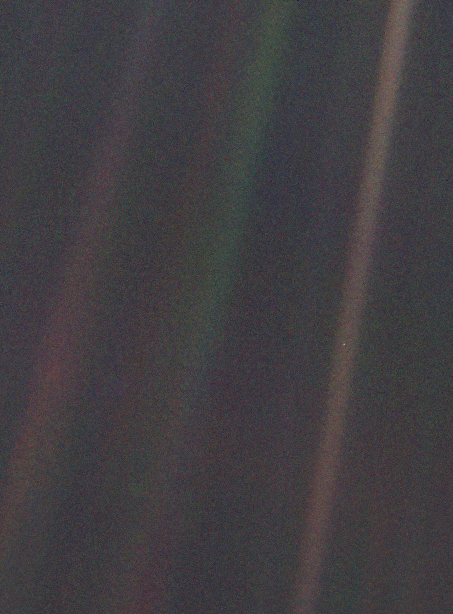
Yes, that's us in the center-right. The tiny speck with a blush of blue. Now watch this short video, with audio from the original Cosmos, as Carl tells us what we can all see in this Pale Blue Dot:
Cosmos: A Spacetime Odyssey premiers the evening of March 9th on your local Fox network.
Subscribe to:
Posts (Atom)