|
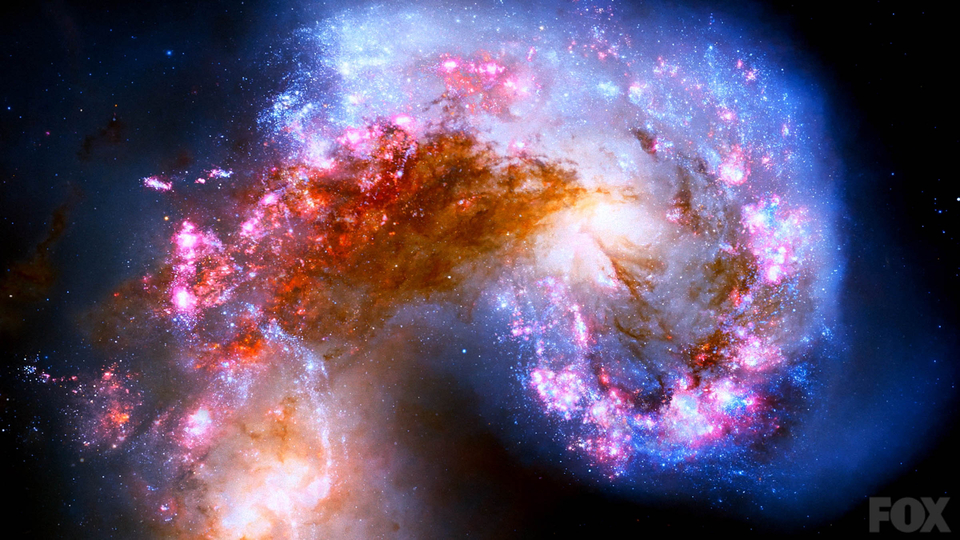
| Hubble's view of the Antennae Galaxies made it on TV! (cosmosontv.com) |
This week, Neil deGrasse Tyson and Cosmos showed us a little bit of how incredibly strange the Universe can be when you just consider that light travels at a finite speed. The jaw-dropping scene above (discovered by William Herschel!) shows two colliding galaxies as they were 45 million years ago because it has taken the light from this titanic gravitational maelstrom that long to reach us. Given that the lifetimes of the largest and brightest blue stars can be as short as a million years or so, much of the light recorded here comes from long-dead stars
—hence the title of this episode.
It's even weirder when you think about travelling at close to the speed of light. Einstein's theory of special relativity basically boils down to "Everyone measures the same speed of light". Then, for emphasis, it adds: "No, I mean it. No matter what absolute nonsense has to be true for that to happen, that's what happens." Note here that "what absolute nonsense has to occur" includes things like time passing more slowly the faster you travel relative to someone else, light shifting wavelengths so that you could see radio waves or gamma rays with your eyes, objects behaving as though they have more mass at high speeds, and on and on.
Then, once you add in the principle that gravity is equivalent to acceleration, you get massive objects bending light travelling past them, clocks running slower the closer you are to a massive object, and those ridiculous objects that are so massive not even light can escape their gravity: black holes.
Oh, and maybe there is an infinite hierarchy of other universes in each black hole.
Let's get started!