Tuesday, September 2, 2014

Organic Panic -OR- How I learned to stop worrying and love the produce section!

This article by Christie Wilcox at Scientific American is a very cool-headed look at the concerns supporting the half of the organic food movement concerned with pesticide toxicity (for a look at the debunking of claims of more nutritious and healthy organic food, head over here). It does a great job of casting a wide net and hits all the points:

  • Organic pesticides are not less harmful (short or long term) than conventional pesticides. They are often much more hazardous and stick around longer than the conventional equivalent.
  • Conventional pesticides are tightly controlled, with acceptable limits set to 100 times less than the smallest amount shown to cause harm in a wide range of animal studies (short and long term). Typically, levels detected in actual produce are 100 times below the limit, or 10,000 times less than levels necessary to cause any noticeable harm.
  • Organic pesticides do not have these same controls and guidelines because the same regulations don't apply. You don't know what or how much you're eating. I'm not saying that this is necessarily dangerous, just that you're being hypocritical if you avoid conventional foods to avoid unknown effects of low exposures to pesticides. The organic pesticides are the (relatively) unknown, unstudied, untested option.
  • Organic and conventional farmers show no difference in their overall health, for those of you worried about their exposure.
  • Most pesticide exposure is environmental, and doesn't even come from food-related use of pesticides!
  • There is even evidence for hormesis (a beneficial effect of exposure levels below that shown to cause harm) for many pesticides and other "chemicals". Weird, but true.

You have to think about the difference between the leafy-green, sunshine and rainbows image that the word "organic" puts in your head and what it actually means. I would also prefer to eat food grown on the farm I imagine when I sing "Old McDonald had a farm", but that's not what's going on. What's going on is the creation of a false perception of danger in order to get you to pay more for less. I'd say that sounds more Animal Farm than Old McDonald.

Monday, May 12, 2014

Death demystified.

"…life does not consist mainly—or even largely—of facts and happenings. It consists mainly of the storm of thoughts that is forever blowing through one’s head."  
—Mark Twain 

Update: I just found this great post over at Math With Bad Drawings, as well as the great little cartoon above which seem to be at odds with what I've said on the topic of death and transferring consciousness. Both use the Star Trek transporter, or something just like it. I wonder if I can convince them that there's nothing to be afraid of about these kinds of transporters? So here is a cleaned up version of my argument on the topic, presented as a thought experiment. Enjoy!

Think for a moment about what it's like to die.

Don't worry about how you got that way; there's no need to be gruesome! Just think about what it would be like to experience the moment or process of death, absent all of the messy, external confusions. If you think there is an experience of being dead that comes afterward, try and imagine that experience. Consider what you could imagine others coming up with in response to such a question. Imagine what your friends might think of death. Picture the death experience of anyone else—a psychic medium, a skeptic, a clergyman, an atheist, a neurologist, a suicide bomber—and just come to a conclusion about which one you think is most likely to be the actual experience for you before you read any further, OK?


Good. Now think of your favorite animal with a silly hat on. You just died. How was it?


Obviously you're not dead and you didn't just die insofar as we understand those words at the moment, but what I'm going to try and convince you of over the course of this blog post is that death (the root experience, not all the moaning and groaning leading up to it) is not really any different from the moment between two thoughts.


Thursday, May 8, 2014

Cosmos "Lost Worlds of Planet Earth": Nitpicks, Nods, and News

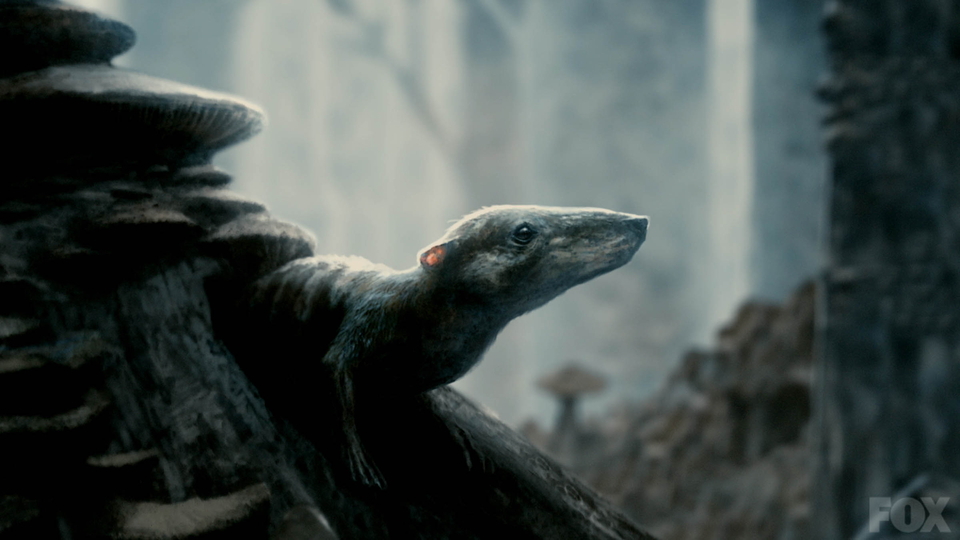
Perhaps all of our great^N-grandmother. (cosmosontv.com)
This episode was a fantastic look at the amazing story of the skin of our home planet, how we came to understand the Earth's history and how it literally set the stage for us all, from the first human to spark a chunk of flint to Shakespeare to you. We learned about mass extinctions and how they gave rise to new eras dominated by different groups of living things, we saw how an overabundance of indigestible plant matter in one epoch became the coal that burned millions of years later to fuel the chain of events that resulted in the Great Dying, and we saw how a tiny isthmus halfway across the globe forced tree-dwelling apes onto the Savannah, eventually forcing them to evolve into you, me, and everybody else.

Unfortunately, the FOX station in New Orleans is apparently run by a producer or two who have yet to make the ape-human transition and didn't want us to hear about it. A friend of mine claims to have seen a similar event to that which made meager headlines in Oklahoma, where the local FOX station cut to a nightly news promo to cover up Neil deGrasse Tyson's mentioning of human descent from the trees. Creationists like this are beyond reproach for their actions, because they obviously haven't even considered the value of viewpoints other than their own, but that doesn't stop me from feeling very, very sorry for them and their myopic little cage in which they lock their intellects.

But that shouldn't stop us from having all the fun they're missing, so let's move on and talk about something interesting!

Thursday, May 1, 2014

Cosmos "Sisters of the Sun": Nitpicks, Nods, and News

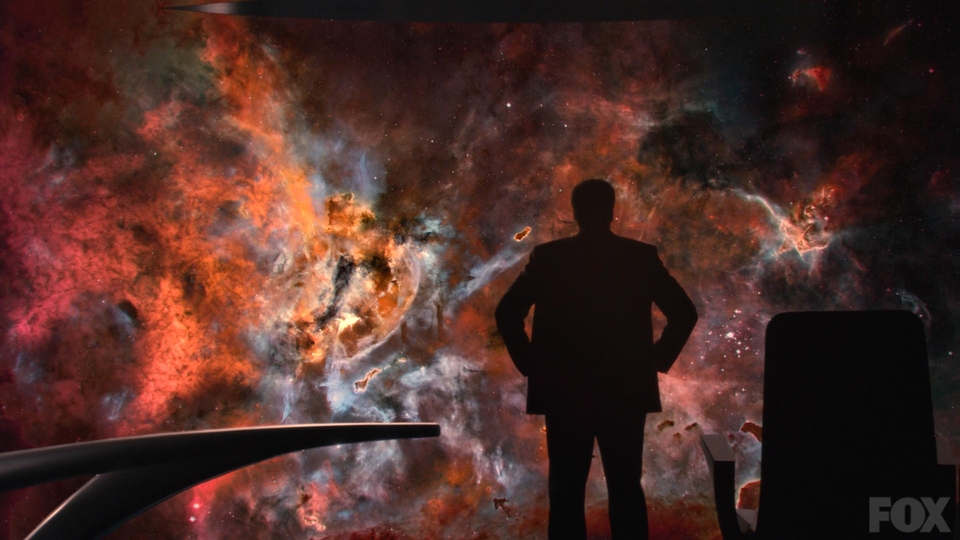
The Carina Nebula is a bustling stellar recycling plant. (cosmosontv.com)
The last two episodes have been wonderful. Both have been able to be much more focused on their respective topics and this episode even delved into a bit more depth than we ever usually see on popular science shows with the short segment on stellar spectral classification. Further, we got to see a second example of scientific growing pains, those first few moments in the life of a profound discovery where it is vulnerable to being quashed and forgotten. Last week's debate over the use of lead in gasoline was due to profit, but this week's rejection of the discovery of the dominance of hydrogen and helium in stellar spectra was due to prestige; scientists can be just as vulnerable to closed-mindedness as the rest of society and must constantly check our biases when examining the data. The importance of keeping an open mind must be constantly balanced against the filtering power of skepticism. Too much of the latter and you'll miss new ideas and discoveries that will advance human knowledge. Too much of the former and you'll... well... do you guys ever watch the History Channel?

But let's move on. There was a lot of mind-blowing science in this episode, so let's get started!

Sunday, April 27, 2014

We can afford a fully-funded NASA

The group Space Advocates, which I support with a few dollars monthly, has produced this cute video highlighting the broad talking points of how sad the state of funding for NASA is, and how little it would cost us to fix it. Check it out!


Here are a few ways to bring this conversation into the spotlight:
  1. Share this video!
  2. When space comes up in conversation, mention how pathetic it is that we spend many times more money subsidizing the already-booming oil industry than we do maintaining our slipping hold on leadership in space exploration.
  3. Point out that NASA's budget is 40 times smaller than the military's budget. Build rockets, not bombs!
  4. Mention that we will very soon (after 2017) have ZERO functioning spacecraft exploring the outer planets, some of which have moons that could potentially harbor life. The reason? These planets are far away and more costly to reach. That's like hearing there might be treasure buried in your backyard and complaining about how far it is from the couch.
  5. "We should solve our problems here on Earth before we go mucking around in space." Sigh... You are bound to hear this. It's pretty easy to just point out that we already spend 100 times more on social programs to solve problems down here, and that we spend about as much per year on the military (which the kind of person using this excuse might say is spending money on making problems) as we have on all NASA programs in history combined.
There are a lot of other things you can do, but the best thing is to just take a moment to think about how big of an impact we can make if we just turn this into an issue that people care about. Once you've thought about how this matters for a few minutes, then it's a good idea to check out the Space Advocates "Get Involved" page. They'll give you an easy way to write to Congress.

Don't stop there, though! Ask about candidates' positions on the state of funding for space exploration when they're on the campaign trail. If you can get someone to comment on it publicly, their opponents may be forced to join in. Don't give up. It's hard to get the Leviathan moving, but once it's gained momentum we can do great things: See Apollo Program, ISS, Hubble, Cassini, Voyager, Curiosity, and on and on.

Thursday, April 24, 2014

Cosmos "The Clean Room": Nitpicks, Nods, and News

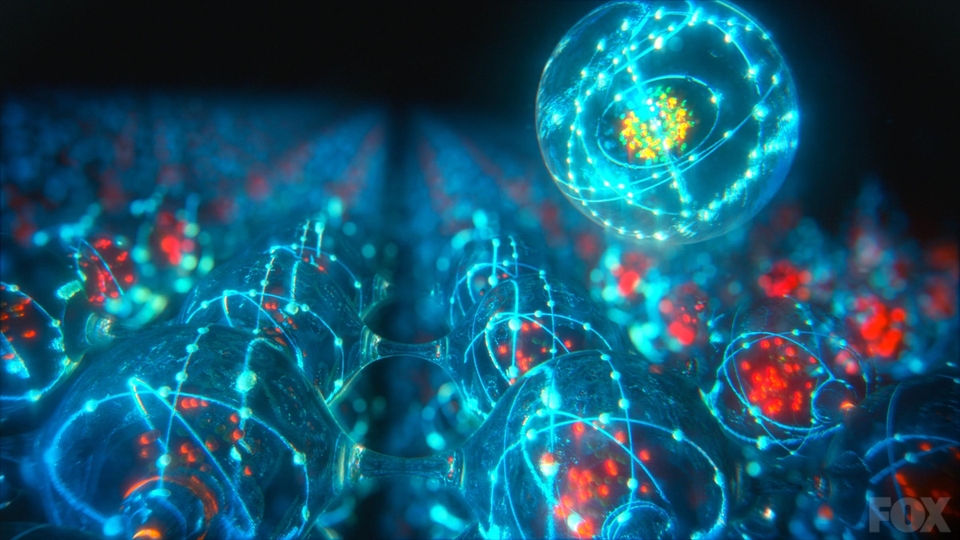
The beauty of crystalline solids on the atomic scale. (cosmosontv.com)
The Bible is hilariously wrong about the age of the Earth, Christmas is just a pagan holiday repurposed by the young Church to attract more converts, and the global warming "debate" is the result of a smokescreen operation on par with those put forward by the lead and tobacco companies to selfishly risk the public health to avoid a hit to their profit margins. For conservatives, truth bombs abound in this episode. Are we still watching FOX? This honest, pull-no-punches approach is all too rare in today's climate of "You believe what you want as long as I don't have to hear about it." Science is founded on questions first and foremost, so it's easy to be laissez-faire with people's deeply-held opinions, but science is also in the business of knowledge and when we work something out to a practical certainty we shouldn't mince words to shelter others from the truth.

So if you're ready to learn more, but especially if you're not, click on through...

Wednesday, April 16, 2014

Cosmos "Deeper, Deeper, and Deeper Still": Nitpicks, Nods, and News

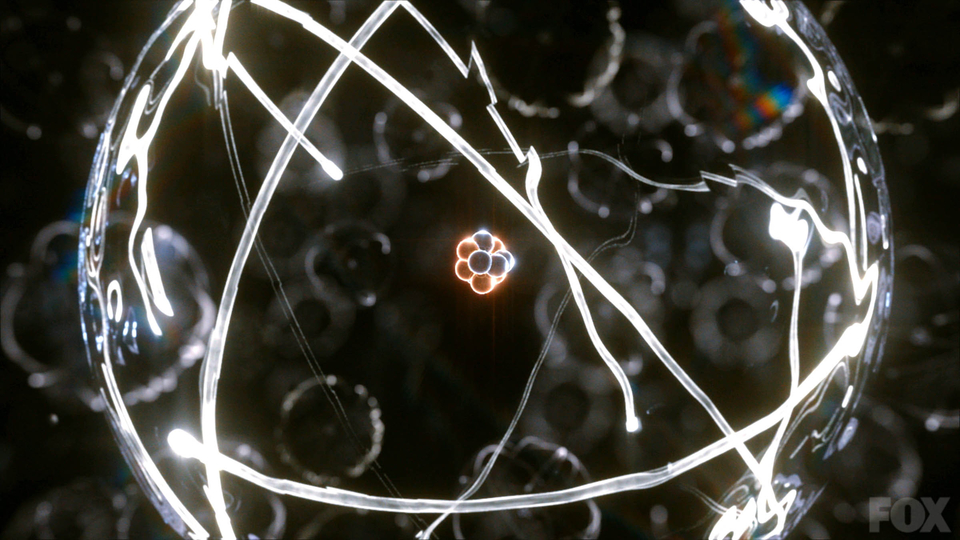
This week takes us from the farthest we can see in the universe to the tiny heart of an atom. (cosmosontv.com)
This week's episode took us from the unfathomably enormous to the unimaginably tiny, with stops along the way at the mind-bendingly complex. We learn immediately that there are more atoms in the tip of your little finger than there are stars in the observable universe, so you know that atoms must be small. Then later in the episode we learn that if an atom were scaled up to the size of a cathedral, the nucleus would be no bigger than a mote of dust. One thing that could have been mentioned here is that the nucleus contains essentially all of the mass of an atom, which makes it incredibly dense. If you could somehow fill a teaspoon with matter as dense as an atomic nucleus, it would weigh 2 billion tons, or about 330 Great Pyramids of Giza. It would be so massive that from about 3.7 meters away (12 feet) it would have the same gravitational pull on you as does the entire Earth. Luckily, these super-dense objects are safely cocooned and separated from one another inside their diffuse electron clouds, which also happen to do all of the chemical bonding work necessary to build complex molecules like DNA and ethanol.

If you thought that was cool, come deeper still and let's get down to nitpicks.